
Category: Competitive Landscapes
-

4 Arbitrage & Comparison Engines Tools for Prediction Markets
This category covers tools that compare prediction markets across platforms to surface pricing differences and arbitrage opportunities. By aggregating real time odds, fees, and liquidity, they help users identify best prices or risk free spreads. These engines also contribute to market efficiency by aligning prices across venues and improving overall probability signals.
-
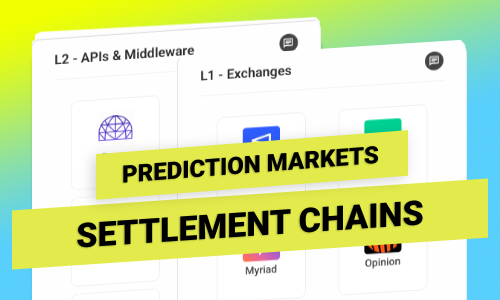
2 Settlement & Execution Chains used by Prediction Markets
This category covers the base blockchains that prediction markets rely on to execute trades, hold collateral, and finalize settlement. These chains provide shared ledgers where transactions are ordered, positions updated, and outcomes enforced. They act as the execution rails beneath exchanges, ensuring reliability, finality, and global consistency of market state.
-
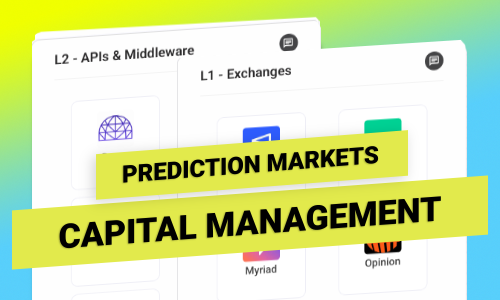
3 Capital Management Tools for Prediction Markets
This category covers capital management tools that turn prediction market positions into long lived financial assets. By enabling lending, delegated funds, and automated reinvestment, these platforms reduce capital lock-up and introduce leverage, diversification, and yield. They shift prediction markets from isolated bets toward managed portfolios and institutional style financial infrastructure.
-
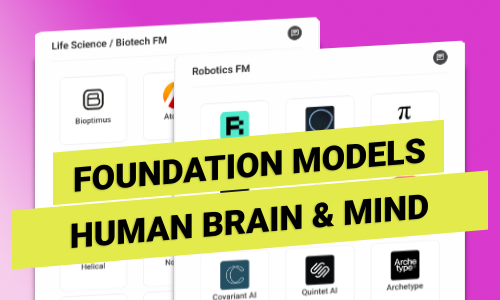
4 Startups Building Human Centered Foundation Models
This category covers foundation models designed to understand human cognition, emotion, and behavior. Trained on neural, psychological, and multimodal signals, these models infer internal states like mood, attention, or intent. They enable emotionally aware agents, mental health tools, and brain-computer interfaces, forming a new intelligence layer centered on human inner states.
-

4 Startups Building Market Analytics & Intelligence Tools for Prediction Markets
This category focuses on analytics and intelligence tools that turn public prediction market data into actionable insight. By tracking wallets, volume, and price dynamics, these platforms help users understand conviction behind the odds. They act as the research layer of the ecosystem, revealing how information and capital actually flow.
-

5 Startups Building Foundation Models for Manufacturing
his category focuses on foundation models built for manufacturing and industrial systems. These models learn from sensor data, machine telemetry, and production video to support autonomy on the factory floor. They power use cases like control generation, quality inspection, fault detection, and process optimization across complex industrial environments.
-

14 Startups Building Trading Apps & Terminals for Prediction Markets
This category covers the trading terminals, bots, and agents that turn prediction markets into executable workflows. These tools sit at the edge of the ecosystem, translating signals and intent into trades. They emphasize speed, automation, and usability, shaping how capital actually moves as information becomes a tradable asset.
-
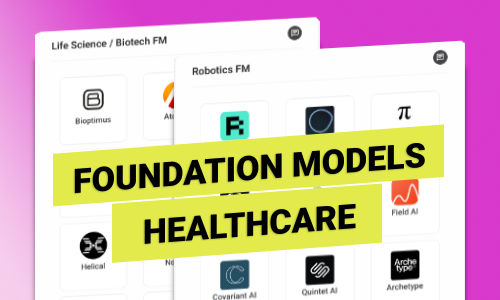
9 Startups Building Healthcare Foundation Models
This category covers startups building healthcare foundation models trained on clinical, imaging, and patient data. These models aim to support diagnosis, documentation, care coordination, and decision support across workflows. By combining text, images, and signals, they act as core medical intelligence layers rather than single task tools.
-
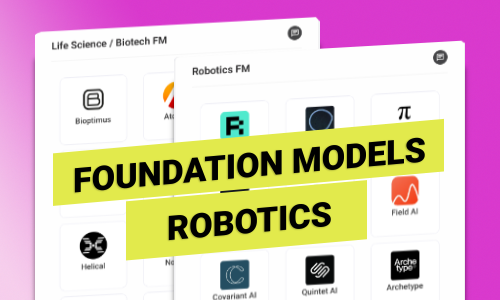
9 Startups Building Robotics Foundation Models
This category covers startups building foundation models that give robots general perception, reasoning, and control capabilities. These models learn from large-scale sensor, video, and simulation data to operate across tasks and environments. The goal is reusable robotic intelligence that transfers across hardware, settings, and applications rather than task-specific automation.
-

6 Startups Building APIs & Middleware for Prediction Markets
This category covers the infrastructure layer that powers prediction markets. These APIs and middleware tools aggregate data, normalize market signals, and enable real-time access across platforms like Polymarket or Kalshi. They turn fragmented market data into programmable intelligence that developers, traders and AI agents can reliably build on.
-

21 Startups Building Biotech & Life Science Foundation Models
This post explores startups building foundation models trained on biological data such as DNA, RNA, proteins and cell states. These domain specific models act as core infrastructure for biotech research, enabling faster drug discovery, target identification and therapeutic design by learning general biological patterns from massive, multi-modal datasets rather than narrow, task specific models.
-

5 Startups Building Athlete Scouting Platforms
Athlete scouting platforms help clubs, academies and agents identify, evaluate and compare players by combining video, performance data and structured reports. These tools centralise scouting workflows, reduce the time required to review footage and broaden the visibility of talent beyond traditional scouting networks.