
This post is part of a series covering the Prediction Market ecosystem. You can view the full interactive map with more than 60 startups here.
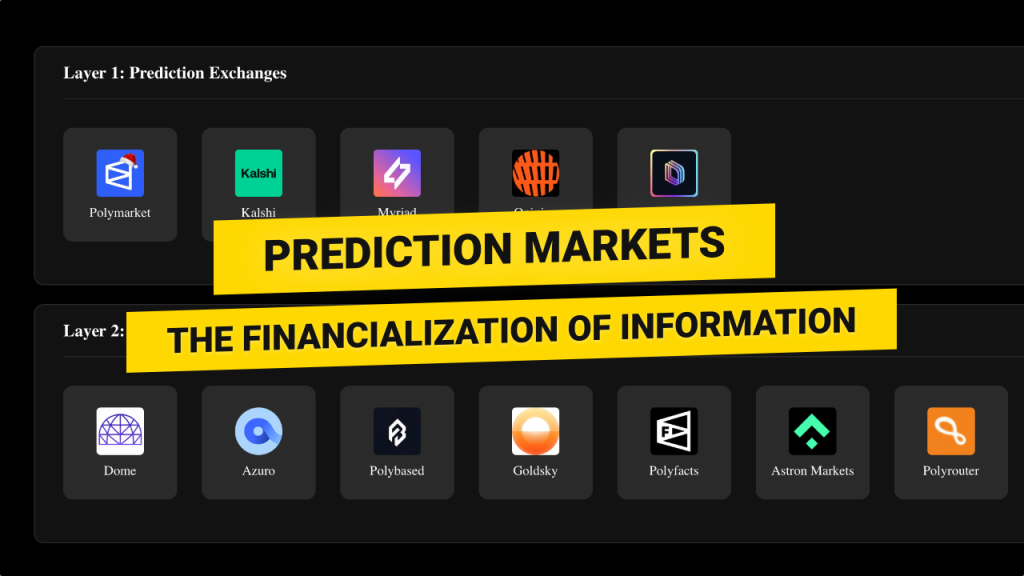
This market map represents the “financialization of information” (Think of Polymarket and Kalshi as the current main exchanges). In this ecosystem, world events are treated like stocks, and the tools below are what traders, developers, and everyday users use to navigate this new economy.
Settlement & Execution Chains
What this category is about?
This category represents the base infrastructure on which prediction exchanges operate. These protocols provide the execution environment where trades are recorded, collateral is held, and settlements are finalized. While exchanges define markets and manage liquidity, these rails ensure that transactions are executed reliably and state changes are enforced globally.
How does it works?
When a trade is placed on a prediction exchange, it ultimately becomes a transaction that must be executed, ordered, and finalized on a shared ledger.
Layer 0 rails handle transaction processing, block production, finality, and state storage, making sure that ownership, balances, and positions are updated consistently across the system.
What lives in this category:
- Public blockchains that provide transaction execution, data availability, and final settlement.
- Native asset and stablecoin rails used for collateral, margin, and payouts.
- Consensus and finality mechanisms that guarantee trades cannot be reverted once settled.
Relationship to Layer 1 exchanges
Prediction exchanges can build sophisticated market logic and trading interfaces, but they rely on these rails to execute trades and enforce outcomes. Some exchanges tightly couple themselves to a single chain, optimizing for speed and cost. Others remain chain-agnostic and deploy across multiple rails to reach different user bases.
2 Settlement & Execution Chains used by Prediction Markets

What is Solana?
- Solana is a public blockchain designed to execute transactions and smart contracts at very high speed and low cost.
- Solana was launched in 2020 with the goal of solving blockchain scalability by combining proof of stake with a time ordering mechanism called Proof of History.
- It gained prominence by enabling on-chain applications that require high throughput and low latency, such as order-book exchanges, derivatives platforms, and real-time financial markets.
- Solana has become a preferred execution layer for several crypto native prediction markets and trading protocols like Drift.
How prediction markets use Solana?
- Kalshi uses Solana to issue tokenized versions of its prediction contracts, allowing positions from its regulated markets to be represented and traded on chain and integrated into the Solana DeFi ecosystem, while the core exchange logic and regulatory settlement remain off chain.
- Drift.trade (Drift Protocol) is a decentralized exchange built directly on the Solana blockchain.

What is Polygon?
- Polygon is an Ethereum scaling ecosystem that provides multiple execution networks compatible with Ethereum while reducing cost and congestion.
- Polygon started as Matic Network, initially offering a proof-of-stake sidechain to scale Ethereum transactions.
- It evolved into a broader platform supporting multiple scaling approaches, including sidechains and zero knowledge networks.
How prediction exchanges use Polygon
- Exchanges use Polygon as a cost efficient execution layer while maintaining compatibility with Ethereum tooling, wallets, and standards.
- It enables smaller trades and higher participation by reducing transaction fees for market entry, trading, and settlement.
- Polygon is often chosen by prediction markets targeting broader retail audiences rather than high frequency professional traders.
- Polymarket uses Polygon as its primary settlement layer.