
This post is part of a series covering the Prediction Market ecosystem. You can view the full interactive map with more than 60 startups here.
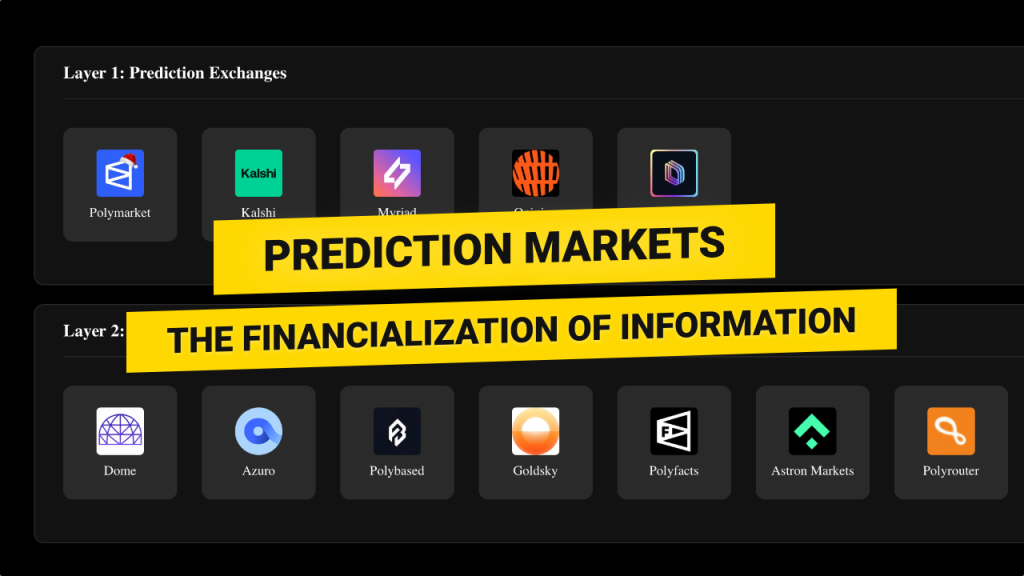
This market map represents the “financialization of information” (Think of Polymarket and Kalshi as the current main exchanges). In this ecosystem, world events are treated like stocks, and the tools below are what traders, developers, and everyday users use to navigate this new economy.
Settlement & Computing Protocols
What this category is about?
This layer provides the trust and computation primitives that make prediction exchanges possible in the first place. While exchanges turn real world events into tradable markets, this category ensures that outcomes can be verified, computed, and settled in a way that participants can trust.
How does it work?
Once an event has occurred, the system must answer a simple but critical question: what actually happened? Tools in this category handles this by sourcing external data, verifying outcomes, and enforcing settlement rules through cryptographic or economic guarantees rather than discretionary decisions.
- Prediction exchanges may build parts of this logic in house, especially around market specification and resolution rules. However, many rely on Layer 0 systems for the hardest problems: sourcing trustworthy data, performing verifiable computation, and enforcing outcomes without centralized trust.
- In practice, this means an exchange can focus on market design, liquidity, and trading experience, while Layer 0 acts as the neutral referee that guarantees outcomes are resolved fairly and consistently.
Why this layer matters?
- Without verifiable settlement and computation, prediction markets collapse into opinion polls or discretionary betting platforms. Layer 0 is what allows information to be financialized at scale, because it replaces trust in an operator with trust in transparent, auditable systems.
Annex
How verifiable oracle and computation tools work in practice
Using UMA as an example, these tools are designed to answer a simple question reliably: is a given statement about the real world true or false, without trusting a single operator.
Optimistic reporting:
- Any party can propose a value or outcome, for example a price, a fact, or a boolean statement.
- The system assumes the proposed value is correct by default, which keeps costs and latency low.
Economic guarantees through bonding
- The proposer must post a bond when submitting the value.
- This bond acts as collateral that can be slashed if the value is proven wrong.
Open challenge period
- A fixed dispute window is opened after submission.
- During this time, anyone can challenge the proposed value by posting a counter bond.
- This turns verification into an open, permissionless process rather than a trusted feed.
Decentralized resolution
- If a dispute occurs, the question is escalated to UMA’s Data Verification Mechanism.
- Token holders vote on the correct outcome using publicly available evidence.
- The majority decision becomes canonical and is enforced by the protocol.
Finality and enforcement
- Once resolved, the outcome becomes immutable at the protocol level.
- Smart contracts relying on this data automatically execute based on the verified result.
- Bonds from incorrect submissions are redistributed to honest participants.
5 Verifiable Settlement & Computing Protocols used by Prediction Markets

What is UMA?
- UMA is a decentralized optimistic oracle protocol that lets smart contracts verify and record real-world data on blockchain in a trust-minimized way. This “truth machine” makes arbitrary external information available on-chain without relying on centralized data providers.
- UMA was initially conceived by Risk Labs with the aim of solving the oracle problem for broad types of data, beyond simple price feeds. It built its first optimistic oracle as a primitive that could serve many smart contracts and DeFi use cases.
- Over time it gained prominence as one of the first oracles capable of verifying not just objective market data but also custom statements and outcomes that smart contracts need to resolve, such as event outcomes or governance results.
- Major protocols have integrated UMA’s oracle. For example prediction markets like Polymarket rely on its optimistic oracle for outcome resolution, and cross-chain bridges like Across Protocol use it for verifying transaction finality trustlessly.
Major features:
- Optimistic verification model. Proposals are assumed correct unless challenged within a defined window, reducing cost and latency compared with push-based oracle models.
- Decentralized dispute resolution. If data is contested, UMA uses a Data Verification Mechanism where token holders vote to determine the correct outcome.
- Flexible data support. It can verify a wide range of data types, including price feeds, event outcomes, governance results, and bespoke conditions, making it useful across DeFi, prediction markets, insurance, and more.
- Economic incentives. Proposers and disputers post bonds, and honest participation is rewarded while bad actors lose stakes, aligning incentives for accurate reporting.

What is Brevis Network:
- Brevis Network is a system that lets blockchain applications use data from outside their own network, or from other blockchains, while being able to prove that this data and the way it was processed are correct.
- Brevis was created to solve a limitation of traditional oracles, which is that they deliver data but do not prove how that data was computed or derived.
- It has been adopted by new generation prediction market protocols such as Opinion, where Brevis is used as part of the settlement and verification stack to prove real-world outcomes in a trust-minimized way.
Major features:
- Zero-knowledge verification of data and computation. Brevis generates zk proofs that attest not only to the data used but also to the correctness of the computation applied to it.
- Off-chain and cross-chain data access. The protocol can query historical blockchain state and external data sources and make the result verifiable on chain.
- Settlement grade guarantees. Designed for use cases like prediction markets, insurance, and financial primitives where outcome correctness is critical and disputes must be minimized.

💰 Series A
What is RedStone Finance?
- RedStone is a modular blockchain oracle network that delivers fast, secure, and flexible external data to smart contracts and decentralized applications across many chains.
- RedStone was founded to address limitations in traditional oracle systems by introducing a modular oracle design that separates data sourcing, distribution, and on-chain delivery.
- It has expanded quickly, operating on 50+ chains with feeds for 1300+ assets and securing data used by DeFi protocols with billions in total value.
- The project has raised a $15 million Series A round led by Arrington Capital with participation from major crypto investors such as Kraken Ventures and Amber Group, bringing its total disclosed funding to around $23 million.
- RedStone’s oracle services are used by major clients in the DeFi ecosystem.
Major features:
- Modular and scalable oracle architecture. RedStone separates data acquisition, distribution, and on-chain verification so components can evolve independently.
- Push & pull delivery models. It supports both push based and on demand “data-on-transaction” delivery, reducing blockchain storage and gas costs.
- Cross-chain coverage. Feeds are available across many EVM and non-EVM networks.

What is Pyth Network?
- Pyth Network is a decentralized oracle network that delivers real-time financial market data, especially asset prices, directly to blockchain applications.
- Pyth originated within the Solana ecosystem, initially backed by major trading firms and exchanges that wanted to publish high-quality price data on chain rather than relying on third-party aggregators.
- It gained prominence by introducing a pull based oracle model, allowing applications to request fresh price updates on demand instead of relying on continuously pushed feeds.
- Pyth is now used across many chains and by a wide range of DeFi protocols, including derivatives exchanges, lending platforms, and increasingly prediction markets that require reliable and timely price or market data.
Major features:
- First party data sources. Prices are published directly by exchanges, market makers, and trading firms, reducing reliance on intermediaries.
- Real time, low-latency feeds. Designed for use cases where price freshness matters, such as derivatives, liquidation logic, and time sensitive markets.
- Pull based update model. Applications choose when to fetch and pay for updated data, improving efficiency and cost control.
- Cross chain distribution. Pyth feeds are available across multiple blockchains, enabling consistent data access across ecosystems.

What is Switchboard:
- Switchboard is a decentralized oracle network that connects real world data, APIs, and off-chain information to smart contracts across multiple blockchains, ensuring that on-chain applications can access fresh, reliable data in a trust minimized way.
- Switchboard began as a community driven oracle project focused on providing flexible, developer-friendly tools for bringing off-chain data on-chain without centralized points of failure.
- Over time it has been integrated into a variety of DeFi and Web3 applications across Solana and other ecosystems, making it a well-adopted alternative to more rigid oracle systems. Kalshi uses Switchboard as one of its solutions.
Major features:
- Decentralized feed creation. Multiple independent node operators can serve data, preventing single points of failure and increasing resilience.
- Flexible data sources. Developers can build custom feeds from APIs, market data, event outcomes, or other off-chain inputs.
- Multi-chain support. Switchboard operates across multiple blockchains, enabling consistent data access for cross-chain applications.
- Custom validation logic. Projects can define their own rules for aggregating, verifying, and delivering data.