
This post is part of a series covering the Domain Specific Foundation Models (DFSM) which are industry or use case specific Foundation Models. You can view the full interactive map with more than 70 startups here.
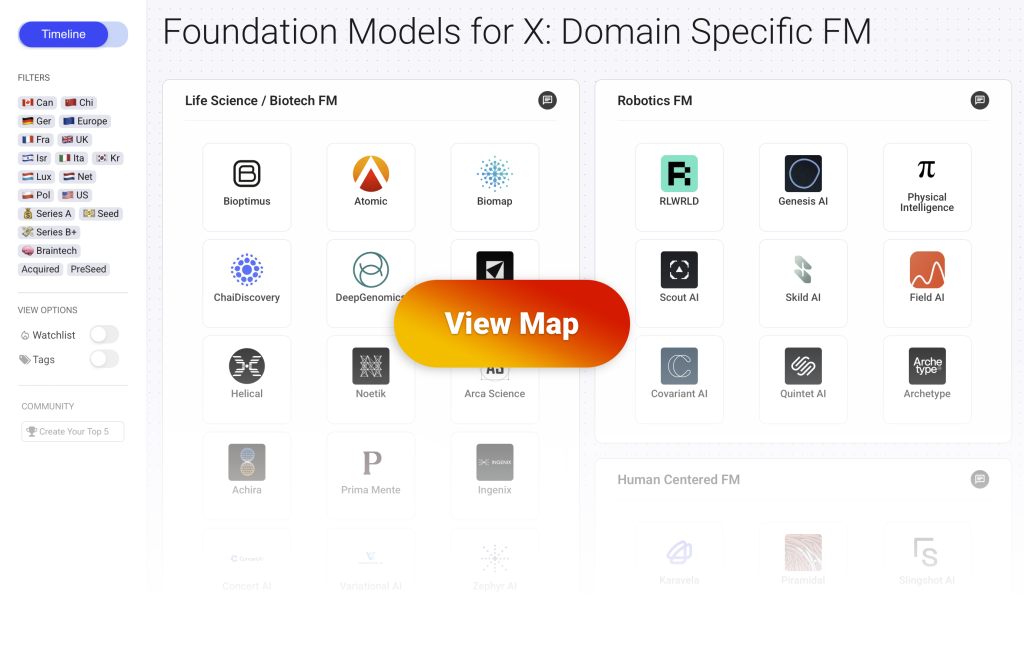
This landscape highlights the startups building specialized foundation models (DSFM) across industries. These are companies whose core product is a large scale, pre-trained model built for a specific domain (biology, brainwaves, robotics, law, etc.). They commercialize their domain specific foundation models either “as a service” to third party applications or directly as an application.
Healthcare Foundation Models
What is this category about?
- Startups in this category build foundation models trained on medical, clinical, and patient data to support a wide range of healthcare use cases.
- These models are developed to understand complex medical information including imaging data, clinical text, lab results, and patient provider interactions.
- The goal is to improve decision support, care coordination, diagnostics, documentation, and communication across both clinical and operational workflows.
- Applications include radiology and pathology analysis, medical report generation, virtual care agents, population health modeling, and clinical summarization.
- Models are often multimodal, combining modalities such as CT scans, histopathology slides, lab values, and physician notes into a unified medical reasoning system.
- Commercial offerings range from clinical copilots and diagnostic platforms to API first infrastructure and care agent deployments tailored to providers, insurers, and health systems.
How is data generated and accessed?
- Data for these models comes from large scale clinical environments and includes radiology images, pathology slides, electronic health records, transcripts, prescriptions, and time series vitals.
- Some companies build proprietary datasets by collaborating directly with hospitals, imaging centers, or national health networks under strict privacy and compliance protocols.
- Others access curated medical datasets from licensed providers, academic research collaborations, or de-identified public health records released under open science initiatives.
- Imaging models are trained on annotated CT, MRI, and histology slides, often paired with clinical outcomes, diagnostic labels, or physician impressions
- Language models in this space are trained on medical dialogues, notes, and documentation.
- In some cases, synthetic clinical data is used to supplement rare conditions or underrepresented patient profiles, especially during early model training.
- Obviously privacy, regulatory alignment, and security are key, with most companies operating under HIPAA or GDPR-compliant frameworks.
9 Startups Building Healthcare Foundation Models
🇪🇺 Europe – 🇫🇷 Fra – 💵 Seed
What they do:
- Raidium develops multimodal foundation models for precision radiology that can interpret CT, MRI and other medical images with broad generalisation across tasks.
- Their flagship model, Curia, is trained on very large clinical imaging datasets so it can recognise anatomy, detect pathology and support more advanced reasoning than narrow diagnostic algorithms.
- The platform integrates these models into an AI native radiology viewer that unifies the entire imaging workflow within a single interface.
Use cases and customers:
- The models help radiologists by accelerating interpretation, automating segmentation and measurements and supporting structured report generation.
- Research teams use the technology to extract imaging biomarkers and run longitudinal analyses that contribute to precision medicine studies.
- Customers include hospitals, radiology groups, clinical research organisations and pharmaceutical teams that need advanced imaging intelligence embedded in daily workflows.

🇺🇸 US – 💸 Series B+
What they do:
- Hippocratic AI develops a safety focused foundation model for healthcare that is trained specifically on medical knowledge, clinical guidelines and patient communication patterns.
- The model is designed to behave as a “supervised agent” that prioritises safety, caution and compliance rather than open-ended generation.
- Their platform includes specialised agents for tasks such as patient navigation, chronic care support and administrative assistance while keeping all outputs aligned with medical best practices.
Use cases and customers:
- Healthcare providers use the technology to extend patient support between visits, offer guidance for chronic conditions and improve access to basic clinical information.
- Hospitals and clinics rely on the agents to manage scheduling, follow-ups, triage questionnaires and other routine tasks that reduce staff workload.
- Customers include health systems, telehealth companies, insurance groups and organisations seeking safe AI tools to improve patient engagement and operational efficiency.

🇺🇸 US – Acquired
What they do:
- Paige builds large scale foundation models for computational pathology that analyse whole slide images at clinical resolution.
- Their core models learn from millions of pathology slides so they can recognise tissue structures, identify cancerous patterns and capture subtle morphological signals.
- The platform combines these models with workflow tools that support diagnosis, research and biomarker discovery across multiple cancer types.
Use cases and customers:
- Pathologists use the technology to assist cancer detection, accelerate case review and improve consistency in interpreting complex tissue samples.
- Research teams rely on the models to discover imaging biomarkers, support drug development studies and analyse large pathology cohorts at scale.
- Customers include hospitals, pathology labs, cancer centres and biopharma organisations that need advanced AI to enhance diagnostic and research workflows.
🇪🇺 Europe – 🇫🇷 Fra – 💸 Series B+
What they do:
- Nabla develops large AI models tailored to healthcare so clinicians can generate clinical notes, summaries and structured documentation from patient encounters efficiently and accurately.
- Their technology combines generative AI with context awareness and clinical reasoning so it can assist with dictation, coding, encounter structuring and other workflows inside electronic health records.
- The platform is evolving into an adaptive agentic system that supports proactive actions such as real-time coding help, retrieval of historical data and automated EHR interactions.
Use cases and customers:
- Clinicians and healthcare providers use Nabla to reduce time spent on documentation, freeing up more focus for patient care and reducing burnout.
- Healthcare teams rely on the models to automate tasks such as medical coding, note generation and workflow guidance across specialties and care settings.
- Customers include hospitals, health systems, clinics and provider groups that need AI solutions embedded into clinical workflows and electronic health records

🇺🇸 US – 💰 Series A
What they do:
- HOPPR develops foundation models for medical imaging that learn visual patterns across many modalities such as X-rays, CT and MRI so AI applications can be built faster and more reliably.
- Their platform, the HOPPR AI Foundry, offers pretrained vision transformer based models trained on millions of curated imaging studies together with secure infrastructure for fine tuning and validation in healthcare settings.
- The company combines these models with traceable data pipelines, compliant workflows and developer APIs so teams can iterate from prototype to clinical-ready solutions with traceability and quality controls.
Use cases and customers:
- Radiology developers and researchers use the models to accelerate creation of AI imaging apps for classification, anomaly detection, report drafting and other diagnostic or workflow tasks.
- Healthcare technology teams rely on the platform to fine-tune imaging models on local data, test performance and integrate outputs into clinical systems such as PACS or EHR workflows.
- Customers include hospital IT groups, imaging vendors, AI developers in healthcare and research organisations looking to deploy robust, compliant imaging AI at scale.

🇺🇸 US – 💰 Series A
What they do:
- Ataraxis AI builds foundation models trained on vast collections of digital pathology images and clinical data so they can uncover patterns linked to cancer progression and treatment response.
- Their main model family, including Kestrel, learns morphological and prognostic features across many cancer types that extend beyond what standard diagnostics capture.
- The platform integrates these models with multi modal clinical information to support personalised oncology decisions and power diagnostic products such as Ataraxis Breast.
Use cases and customers:
- Clinicians use the technology to predict outcomes, assess disease aggressiveness and guide treatment selection for cancers such as breast cancer with improved accuracy.
- Research and precision medicine teams rely on these models to enhance risk stratification and personalise care planning based on imaging and clinical features.
- Customers include hospitals, cancer centres, clinical research groups and health systems seeking to embed advanced AI into oncology diagnostics and treatment workflows.

🇪🇺 Europe – 🇳🇱 Net
What they do:
- Kaiko AI builds multimodal foundation models that learn from clinical data, medical imaging, pathology and genomics so the system can reason across all the information used in oncology.
- Their clinical assistant, kaiko.w, is designed to mirror how clinicians think by understanding longitudinal patient histories and supporting tasks that range from documentation to deeper diagnostic insight.
- The platform trains its models inside a virtual clinical environment where they learn workflows and tool use before deployment in real hospitals to ensure reliability and safety.
Use cases and customers:
- Oncology teams use the assistant to synthesise complex medical data, support diagnosis and guide treatment planning from first presentation to ongoing management.
- The models streamline routine tasks such as preparing notes, structuring referral letters and summarising records while also providing analytical support for difficult clinical cases.
- Customers include hospitals, cancer centres and research oriented healthcare organisations that need AI systems capable of integrating multimodal medical data into everyday workflows.
🇺🇸 US – 💵 Seed
What they do:
- PreemptiveAI builds a biomedical foundation model that learns human physiology and pathology from continuous biosignals collected by smartphones and wearables.
- The model detects patterns in heart rate, blood flow and other biometric signals so it can estimate health states and forecast risks before symptoms appear.
- Their platform turns these real time signals into predictive insights that can be used across clinical care, digital health, pharmaceutical research and insurance.
Use cases and customers:
- Healthcare providers use the technology to predict events such as hospital readmissions or rising risk levels so intervention can happen earlier.
- Digital health and precision medicine teams rely on the model to personalise monitoring and guide preventive care using wearable data.
- Customers include clinicians, health systems, pharmaceutical research teams and insurance groups that need predictive insight from everyday biosignal streams.

🇪🇺 Europe – 🇫🇷 Fra – 💵 Seed
What they do:
- Callyope builds a foundation model for psychiatry that learns from speech, smartphone sensor data and clinical context so mental health symptoms can be monitored continuously and objectively.
- The model captures linguistic, acoustic and behavioural markers linked to conditions such as depression, anxiety, cognitive decline and psychosis so subtle symptom changes can be detected from short interactions.
- Their platform delivers AI agents that support clinicians with symptom assessment, case summarisation, remote monitoring and structured report drafting.
Use cases and customers:
- Mental health clinicians use the technology to track patient symptoms over time, detect early signs of deterioration and personalise treatment plans.
- Care teams rely on the model to streamline tasks such as summarising records, preparing structured notes and monitoring patients outside the clinic.
- Customers include psychiatric practices, hospitals, digital health programmes and research organisations focused on early detection and improved mental health care delivery.