
This post is part of a series covering the Prediction Market ecosystem. You can view the full interactive map with more than 60 startups here.
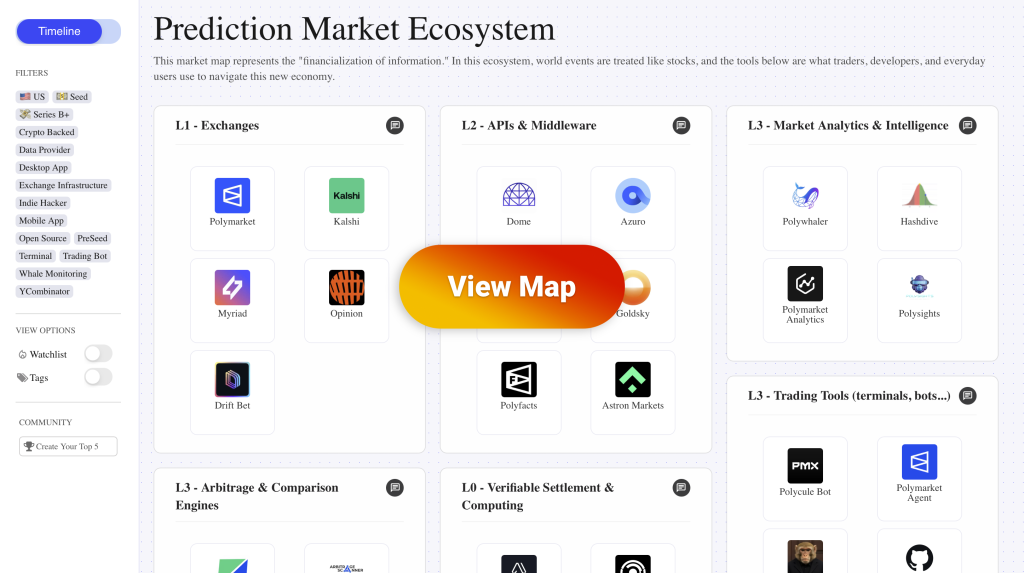
This market map represents the “financialization of information” (Think of Polymarket and Kalshi as the current main exchanges). In this ecosystem, world events are treated like stocks, and the tools below are what traders, developers, and everyday users use to navigate this new economy.
Prediction Markets APIs & Middleware
This category acts as the “Connective Tissue” of the ecosystem. While Layer 1 provides the exchanges, Layer 2 middleware and APIs provides the tools that make those marketplaces accessible, searchable, and programmable for the rest of the world.
What are Prediction Markets APIs & Middleware?
- The Big Picture: This category is the essential “plumbing” that translates raw, complex blockchain data into a format that apps and humans can actually use. It provides a standardized way to plug into multiple prediction markets at once without needing to build custom code for every individual platform.
- Role in the Layer System: Positioned directly between the primary exchanges (Layer 1) and the user facing apps (Layer 3), this layer abstracts away the “messy” technical details. It ensures that if an exchange updates its technology, the apps built on top of it don’t break.
What are the core value provided by these tools?
- Aggregation: It creates a “Single Point of Entry,” allowing a developer to see prices from Polymarket, Kalshi, and others through one single window.
- Real-Time Speed: It provides high-speed data streams (WebSockets) that are critical for professional trading and instant price updates.
- Intelligence Injection: Beyond just raw numbers, tools in this category often “clean” the data, adding AI-driven confidence scores or sentiment analysis to help users understand why a price is moving.
- Cost Efficiency: Instead of every startup building their own expensive data servers, they “rent” the infrastructure from these providers.
- Cross-Chain Translation: They allow an app built on Solana to easily read and interact with a market that lives on Polygon or Base, which is vital for a unified global “Truth Market.”
Who are the main users?
- App Developers: Founders building the next generation of betting interfaces, social apps, or news sites that need live odds.
- Quant Traders & Bot Builders: Professional traders who need high frequency data to run automated arbitrage or hedging strategies.
- AI Researchers: Teams building “Agentic” models that need to read and react to market truths in real-time.
6 Startups Building APIs & Middleware for Prediction Markets

🇺🇸 US – Data Provider – PreSeed – YCombinator
What is Dome?
- Dome is a unified prediction market API and developer infrastructure layer that gives builders real time and historical data across multiple prediction market platforms (including Polymarket and Kalshi) through one consistent interface.
- It enables apps, bots, and analytic tools to pull market prices, orderbook snapshots, wallet data, cross-platform market matching and more without building separate integrations for each exchange.
- Project type: Dome is YC-backed, having been accepted into Y Combinator’s Fall 2025 batch.
- Targets: They target developers, ecosystem builders, traders, quants, and product teams that need prediction market data and infrastructure to power analytics dashboards, automated trading bots, middleware layers, portfolio tools or any other product that consumes prediction market information programmatically.
- Monetization: Follows a tiered API model with free tier access. Info is accessible only through contacting them.
Major and distinctive features:
- Unified multi-platform API. Provides a single integration point that aggregates data from Polymarket, Kalshi and other supported platforms into a consistent schema, reducing development overhead.
- Comprehensive real-time and historical datasets. Exposes live market data, historical price and orderbook history, wallet analytics and filtered search endpoints useful for backtesting and research workflows.
- SDKs and developer tooling. Offers multi-language SDKs (e.g., TypeScript, Python) and WebSocket/webhook support so builders can integrate and stream updates efficiently.

💵 Seed – Exchange Infrastructure
What is Azuro?
- Azuro is a decentralized on-chain prediction market infrastructure protocol that provides smart contract powered tooling, liquidity pooling and real-time data feeds to enable developers and third-party apps to build, host and scale prediction market applications.
- It functions as a base layer for prediction markets rather than a single consumer-facing app.
- Project type: Azuro has raised institutional funding and is backed by venture and strategic investors.
- Targets: They target developers, prediction markets builders, data integrators and third-party platforms.
- Monetization: Protocol operations are tied to on-chain economic incentives. While core data and contract interaction are permissionless, revenue and protocol fees come from market activity and token economics (e.g., liquidity provider returns and governance via AZUR tokens) rather than simple free access.
Major and distinctive features:
- Core protocol infrastructure. A modular on chain system of smart contracts that manage liquidity, odds calculation and payouts for prediction markets without centralized intermediaries.
- Developer SDKs and APIs. Offers indexed subgraph data feeds (e.g., via The Graph) and APIs for real-time and historical market data, enabling external apps to consume this information programmatically.
- Shared liquidity and oracle support. Uses a singleton liquidity pool model and supports oracle feeds, making liquidity and settlement mechanics composable for any app built on Azuro.

Data Provider – Indie Hacker – Open Source
What is Polybased?
- A developer-focused SDK and data access layer that provides real-time prediction market information, including market odds, liquidity, historical data and order book streams.
- It is designed so builders can integrate Polymarket data and trading capabilities into their own applications.
- Project type: Polybased is an independent open source project driven by contributors in the prediction market and developer community.
- Targets: Built for developers, traders, quants, bots and third-party apps that need a programmatic interface to ingest live and historical Polymarket market data.
- Monetization: The project appears to be open source and free to use, distributed with MIT licensing for its SDK.
Major and distinctive features:
- Real-time data SDK. Exposes live market metrics such as current odds, volumes, and order book changes via WebSocket and REST interfaces in a developer-friendly package.
- Historical data access. Allows retrieval of past prices, trades and snapshots useful for analytics, backtesting and signal generation.
- Trading integration layer. Provides tools not just for data but for placing, canceling and managing orders when building bots and automated strategies.

🇺🇸 US – 💵 Seed – Data Provider
What is Goldsky:
- Goldsky is a real-time blockchain data infrastructure platform that provides high-performance indexing, streaming APIs, subgraphs and decoded on-chain feeds across many markets, including dedicated support for prediction market datasets such as Polymarket.
- Project type: VC-backed. Goldsky has raised institutional funding and is positioned as an enterprise grade Web3 data provider used by major protocols and apps.
- Targets: Built for developers, protocol builders, analytics teams and third-party apps that need reliable real time and historical blockchain data to power their products.
- Monetization: Offers a tiered API and infrastructure model with a free tier to get started, and paid plans or enterprise support for higher throughput, custom pipelines and production-grade SLAs.
Major and distinctive features:
- Cross-market blockchain indexing and streaming. Provides real-time indexed data, decoded events and customized pipelines across many blockchains and markets, including prediction market feeds used by platforms like Polymarket.
- Scalable infrastructure and tooling. Designed with enterprise-grade reliability, compatibility with existing stacks, and data pipelines that support high throughput and resilience.
- Multi-use case support. Beyond prediction markets, Goldsky serves a broad set of data needs across DeFi, wallets, analytics platforms, gaming and more, making it a general blockchain data backbone.

Indie Hacker
What is Polyfactual?
- An AI-driven prediction intelligence provider that generates probabilistic forecasts and confidence signals about real-world events and distributes them for reuse by third-party applications in the prediction market ecosystem.
- Project type: Independent project (Indie Hacker type).
- Targets: Built for developers, trading apps, bots, and analytics platforms that want to ingest machine generated predictions as an input, as well as advanced traders who consume the same signals directly.
- Monetization: Uses a token based access model. Advanced predictions and AI analysis are paid for using the POLYFACTS token, suggesting a pay-per-signal or usage based middleware economy rather than a free analytics site.
Major and distinctive features:
- Prediction-as-a-Service layer. Produces AI-generated outcome probabilities and confidence scores that can be embedded into external products, dashboards, or automated trading systems.
- Machine readable intelligence output. Designed so forecasts are consumed programmatically, positioning Polyfactual closer to a belief or signal provider than a human first interface.
- Context enrichment via news and market data. Uses live information feeds and market signals to continuously update predictions supplied downstream.

Indie Hacker – Trading Bot Infra
What is Astron Markets?
- Astron Markets is a decentralized AI-agent trading ecosystem for prediction markets that uses autonomous agents and predictive intelligence to generate signals, execute strategies, and power downstream trading applications.
- Project type: Independent / indie hacker type
- Targeted users/customers: Developers, quantitative traders.
Major and distinctive features (product is still WIP):
- Autonomous AI agents: A network of agents designed to observe market state, generate predictions, and either feed signals to tools or autonomously execute strategies in prediction markets according to configurable logic.
- Predictive intelligence layer: Agents ingest market data, news, and other signals, distilling them into probability forecasts and actionable signals that can be consumed by other tools, bots, or terminals.
- Delivery: The product is primarily delivered as a decentralized agent ecosystem and API infrastructure rather than a standalone app or visual dashboard. Users interact with it through integrations, APIs, or agent execution engines rather than a front-end UI.