
This post is part of a series covering the billing tech startup landscape. You can view the full interactive map with more than 20 startups here.
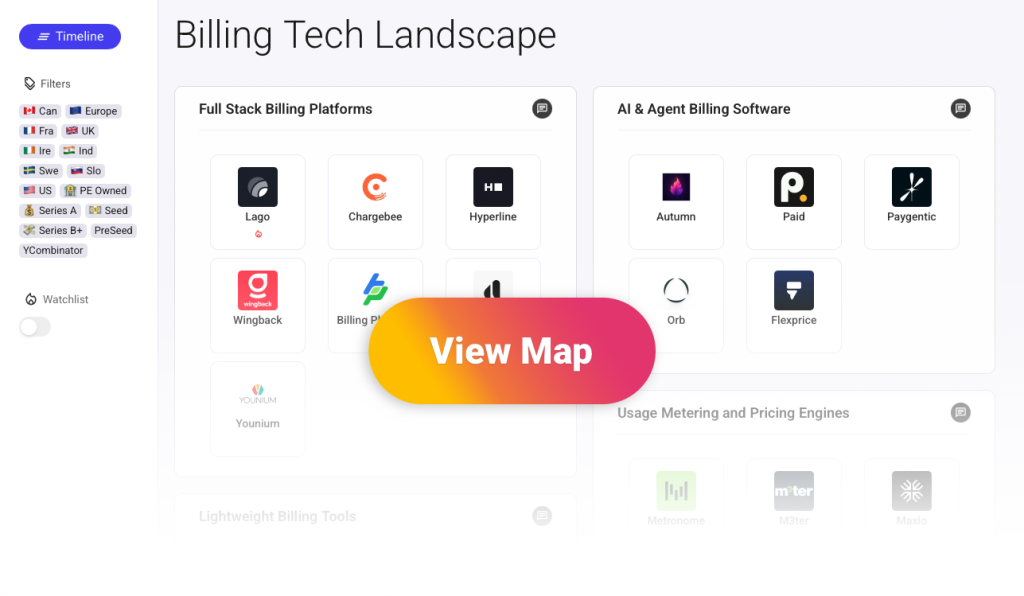
The mapping above covers the new generation of billing tech for B2B software. The goal is to illustrate see how this market is evolving, compare the different approaches adopted by founders and discover the players shaping the future of software pricing.
Billing Tech For AI & Agentic Software
What is the scope of billing platforms for AI and Agentic software?
- They focus on event rich products: AI usage produces dense streams such as tokens, prompts, model calls and agent actions. These platforms ingest and transform these signals.
- They support micro billing units: AI workloads often bill in very small increments like token batches or task executions. The systems handle high frequency metrics with accuracy.
- They enable dynamic and experimental pricing: AI teams test new pricing quickly such as credit wallets, per action tariffs, model tiering or performance based fees.
- They expose developer centric workflows: APIs and SDKs are central, with emphasis on observability, debugging and real time feedback on cost and usage.
- They integrate with AI infrastructure: They connect to model providers, vector databases and agent frameworks to collect fine grained activity data.
How they differ from core billing platforms?
- Core billing focuses on contracts and subscriptions: Traditional systems center on customer lifecycles, invoicing and finance operations, while AI billing centers on usage ingestion and real time costing.
- AI billing must handle much higher event volume: Token level or agent action data requires architectures that scale beyond classic subscription workflows.
- Pricing in AI changes fast: AI teams adjust pricing frequently, which demands flexible models that core billing tools usually cannot support without custom work.
5 Startups Providing Billing Tech For AI & Agentic Software

🇺🇸 US – 💵 Seed – YCombinator
What they do:
- They act as a pricing and billing database for applications built on top of Stripe. It tracks what each customer gets access to, what their usage or limits are, and ties that to payment status.
- They support multiple pricing models including subscriptions, credits, usage-based metering, seat pricing and custom plans so businesses can mix flat fees with consumption-based charges.
- They provide three key API functions for developers: one to handle purchase flows (checkout/attach), one to check access rights (check), and one to track usage events (track).
- They are tailored to fast-moving product led companies (especially in AI / SaaS) that need to iterate pricing quickly and avoid building complex billing logic in house.
Company specificities:
- The product is open source and offers self host options, which gives engineering teams visibility and control over pricing logic and billing state.
- It works as a layer on top of Stripe rather than replacing it.
- It emphasises speed of implementation: you can launch billing functionality very quickly, and then change pricing or add new models without heavy re engineering.

🇪🇺 Europe – 🇬🇧 UK – 💵 Seed
What they do:
- They provide a business engine designed for companies building AI agents. It helps track costs, automate billing and create monetisation models.
- Their platform lets teams define pricing that reflects delivered value rather than only usage or seats. This suits outcome driven agent workflows.
- They give companies tools to monitor model and inference costs which helps protect margins in AI heavy operations.
- They support enterprise deals by enabling custom packaging, negotiated plans and scalable commercial workflows.
Company specificities:
- They position themselves as built for the emerging agent economy. Their focus is on monetising AI agents rather than classic SaaS products.
- The team has a mix of billing expertise and hands on AI agent experience which shapes how the product is designed.
- They emphasise margin control. Rapid shifts in model cost and infrastructure cost require billing tools that can adapt quickly.
- They target early and mid stage AI companies that need specialised monetisation infrastructure tailored to agent based products.

🇪🇺 Europe – 🇮🇪 Ire – PreSeed
What they do:
- They provide a billing and payments platform designed for AI native and agent driven products. It helps companies charge for actions, events or outcomes.
- The system supports monetisation based on any metric a product generates rather than only seats or flat subscriptions.
- It gives teams one unified place for pricing logic, billing execution and payments.
- It targets companies with fast changing usage patterns and real time activity so revenue can follow what agents actually do.
Company specificities:
- They position themselves for the agentic economy where value is delivered through actions performed by AI agents.
- The platform supports flexible models such as hybrid, usage based and outcome based pricing which suits AI products.
- They are an early stage company with a recent pre seed round focused on addressing gaps in AI monetisation infrastructure.
- They emphasise quick setup and light integration so companies can launch and iterate pricing without heavy engineering work.

What they do:
- They provide a billing platform built for companies that rely on usage driven or hybrid pricing. The system captures raw usage events and transforms them into clear invoices.
- It supports many pricing models such as token based, metric based, outcome based or mixed models. This helps companies adjust pricing as they evolve.
- It unifies billing, invoicing and reporting so product, engineering, finance and operations work from the same source of truth.
- It is well suited for AI, cloud and modern SaaS businesses where value is tied to real usage rather than just seat counts.
Company specificities:
- They focus on real time ingestion of usage events which allows the platform to support high volume and rapidly changing activity patterns.
- The system supports fast pricing experiments with tools for plan changes, versioning and no code configuration.
- They position themselves as a revenue design platform for the AI era where pricing moves toward usage or event based models.
- They serve multiple teams across the organisation which shows that billing is positioned as a strategic growth function rather than only an operational task.

🇮🇳 Ind – PreSeed
What they do:
- They provide a usage based billing and pricing platform for AI and agent driven products. Teams can charge per event, per API call or per compute unit.
- The system supports prepaid credits with top ups and expirations which helps companies run credit based or promotional models.
- It handles hybrid pricing that mixes seats, usage, credits and feature based access. Plans can be changed or extended easily.
- It integrates through APIs and SDKs so companies can add billing logic without rebuilding their existing payment setup.
Company specificities:
- They focus on high volume event environments and usage heavy business models such as AI platforms and agent systems.
- They offer open source or self hostable components which gives teams visibility and control over billing logic.
- The architecture is modular and can fit into an existing stack rather than replacing all billing tools.
- They emphasise accurate metering, feature control and developer friendliness which makes the platform appealing to product and engineering teams.