
This post is part of a series covering the billing tech startup landscape. You can view the full interactive map with more than 20 startups here.
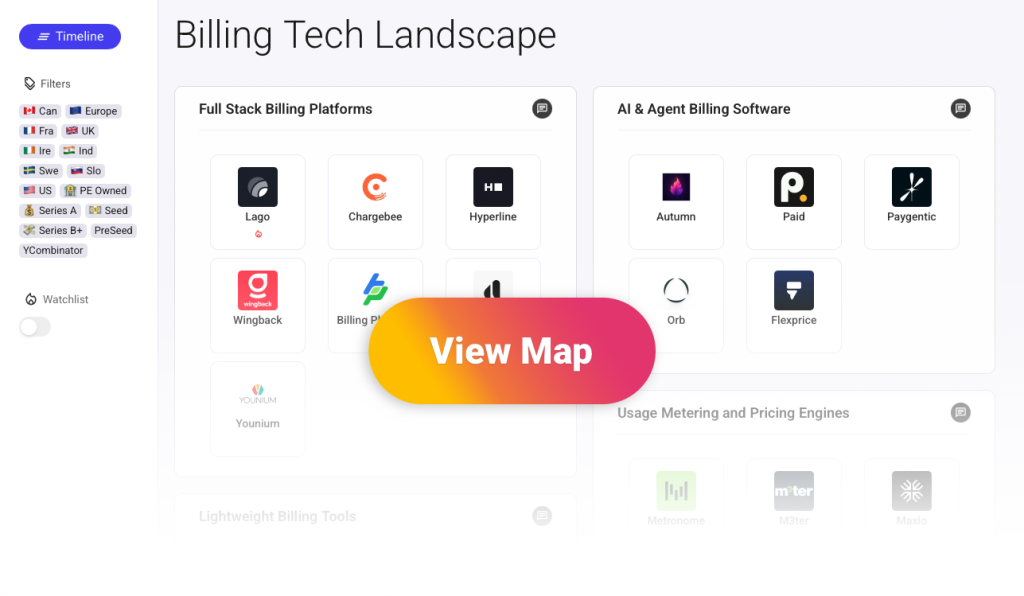
The mapping above covers the new generation of billing tech for B2B software. The goal is to illustrate see how this market is evolving, compare the different approaches adopted by founders and discover the players shaping the future of software pricing.
Usage Metering and Pricing Engines
What is the scope of usage metering and pricing engines?
- They collect raw usage events: These engines ingest signals from product systems such as API calls, data processed, messages sent or device activity.
- They transform events into clean metrics: Raw logs are validated, enriched and aggregated into billable units like requests, gigabytes or active devices.
- They apply rating logic: Teams define pricing rules such as tiers, volume blocks, credits or overage formulas that the engine applies to usage metrics.
- They expose metering APIs for developers: The systems give developers fine control over ingestion, aggregation and pricing via clear API surfaces.
- They hand off outputs to billing systems: They produce the metrics and rated values that a core billing platform uses to generate invoices.
How do they differ from core billing platforms?
- They do not manage subscriptions or contracts: Their focus is usage transformation, not customer lifecycle or invoicing.
- They operate at the event layer: Core billing platforms work with summaries and customer data, while pricing engines work with raw events.
- They are designed for flexibility rather than finance workflows: These engines are built for engineering teams that need custom metrics, not for operations teams managing payments and revenue.
- They are often paired with a billing system: A core billing platform handles taxes, payments and invoices. The metering engine feeds it the accurate usage that drives charges.
4 Startups Providing Usage Metering and Pricing Engines

💸 Series B+
What they do:
- They provide a platform focused on usage based billing. Companies can charge customers based on real consumption instead of only fixed subscriptions.
- The system handles real time metering, pricing logic, invoicing and reporting which turns billing into a strategic tool rather than a constraint.
- It supports both product led and enterprise sales motions so companies can launch new pricing models and iterate quickly.
- It offers clear usage visibility and spend transparency which helps customers understand what they are paying for.
Company specificities:
- They specialise in high throughput event ingestion and real time billing which suits AI, cloud and infrastructure companies with volatile usage patterns.
- They emphasise pricing agility. Teams can create or modify pricing models without heavy engineering cycles.
- Their ideal customers are fast growing companies whose value delivered scales with consumption.
- They are purpose built for modern monetisation trends such as hybrid and usage based pricing rather than legacy seat based approaches.

🇪🇺 Europe – 🇬🇧 UK – 💰 Series A
What they do:
- They provide a usage based billing platform for B2B software companies. It collects raw usage data, rates it and generates accurate bills.
- The system acts as a middleware layer between product usage data and CRM or ERP tools so companies can keep their existing quote to cash stack.
- It supports many pricing models such as hybrid subscription plus usage, credits, top ups and complex plan hierarchies.
- It helps prevent revenue leakage by ensuring that all usage is captured and billed correctly.
Company specificities:
- They focus on real time or near real time usage ingestion which suits companies with high volume or fast changing usage.
- Their integrations with CRM and ERP systems make it easy to slot into existing workflows without replacing core tools.
- The platform is API first and event based which gives teams flexibility to design advanced pricing and billing logic.
- They target mid size and large B2B companies that need to upgrade their monetisation stack beyond basic subscription billing.

🇺🇸 US – 💰 Series A
What they do:
- They provide a billing and financial operations platform for B2B SaaS companies. It automates subscription billing, usage based pricing and global payments.
- The system manages the entire subscription lifecycle including trials, upgrades, renewals and cancellations. It also handles invoicing, reconciliation and collections.
- It supports many pricing models such as flat rate, tiered, volume, usage based and hybrid plans. This gives companies flexibility to test new monetisation approaches.
- It offers real time SaaS metrics and reporting for finance and product teams and connects with common CRM, ERP and accounting tools.
Company specificities:
- It is designed specifically for B2B SaaS which means strong support for enterprise workflows and complex contracts.
- It supports global operations with multi currency payments, varied payment providers and international billing rules.
- It includes financial operations capabilities such as revenue recognition, audit readiness and detailed financial reporting.
- It is aimed at mid size and larger SaaS companies with billing complexity. Smaller companies or extreme usage intensive models may face some limits in agility.

What they do:
- Provided by Zuora, they offer a billing platform that manages usage metering, rating and invoicing for software companies. It helps convert raw events into accurate bills.
- The system ingests product events, aggregates them into meaningful usage metrics and applies pricing rules to generate invoices.
- It supports many pricing models including pay as you go, tiered plans, subscriptions, one time charges, credits and hybrid setups.
- It automates billing and reporting so teams can focus on product and revenue rather than manual workflows.
Company specificities:
- They focus on high volume event ingestion with real time or near real time rating which suits infrastructure, API and AI companies.
- Their pricing engine supports custom rules and flexible metering which gives engineering and product teams room to design sophisticated models.
- They serve multiple functions across the organisation which helps align finance, product and go to market teams around monetisation.