
This post is part of a series covering the 🇪🇺 European defence startup landscape. You can view the full interactive map with more than 60 startups here.
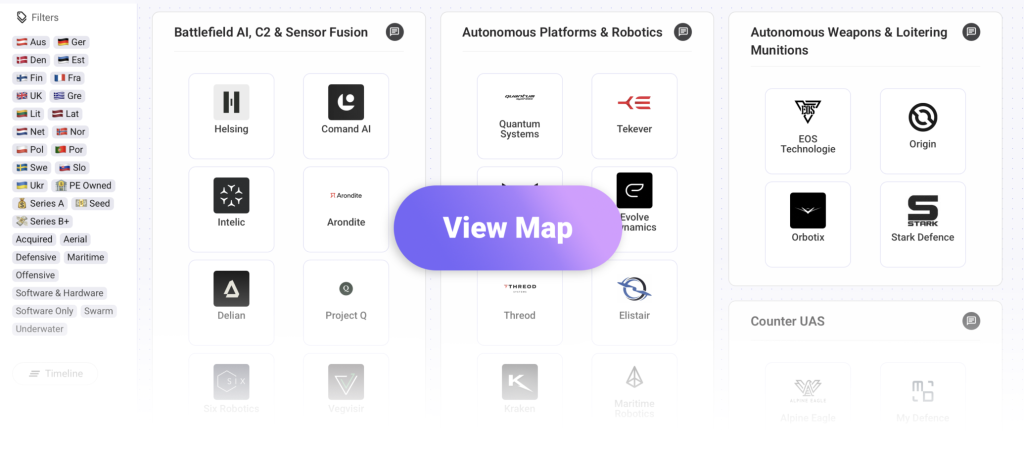
What are “Battlefield AI, C2 & Sensor Fusion” startups?
Companies in this category are building the “brains” of the modern battlefield, software that integrates sensor data, understands the situation, and helps militaries make faster, smarter decisions. These tools fuse radar, video, and radio feeds; spot threats in real time; and coordinate drones, vehicles, or troops from a single command interface.
Think of it as the digital nervous system of defense: Seeing everything, deciding quickly, and orchestrating actions across the field.
While most companies here are software first, some (like Helsing or Anduril in the US) also build their own hardware platforms to showcase their capabilities.
Example capabilities:
- Sensor fusion from multiple platforms: combines inputs from drones, radars, cameras, and other sensors into a single, coherent battlefield picture.
- Target identification with AI: automatically detects, classifies, and prioritizes threats in real time using computer vision and signal analysis.
- Command and control interfaces (C2): allow operators to monitor missions, issue orders, and coordinate units from one central dashboard.
- AI copilots for aircraft or operators: assist pilots and soldiers by suggesting actions, managing sensor data, and reducing cognitive load during missions.
What do Battlefield AI, C2 & Sensor Fusion products do?
- AI decision software: helps commanders analyze data and make faster, smarter tactical decisions.
- ISR data platforms (Intelligence, Surveillance & Reconnaissance): collect and organize intelligence, surveillance, and reconnaissance feeds from drones, satellites, or sensors.
- Combat cloud layers: connect multiple systems on the battlefield, enabling secure data sharing and coordinated operations.
- Digital battle maps: provide realtime situational awareness and visualization of troops, vehicles, and threats.
- Electronic warfare detection and planning tools: identify radio or radar signals and help plan countermeasures against enemy systems.
Glossary
- C2 (Command and Control): Software and systems used to plan missions, issue orders, and monitor battlefield operations in real time.
- C4ISR: Stands for Command, Control, Communications, Computers, Intelligence, Surveillance, and Reconnaissance: The full digital nervous system of modern militaries.
- Sensor Fusion: The process of combining data from multiple sensors (e.g., radar, video, RF) into one clear, accurate picture.
- ISR (Intelligence, Surveillance & Reconnaissance): Tools and operations that gather information about enemy activity using drones, satellites, and other sensors.
12 European Startups Shaping the Battlefield AI Category

🇩🇪 Ger – 💸 Series B+
What they do:
- Builds battlefield AI software for real time sensor fusion, threat detection, targeting, and command decision support.
- Their core platform ingests radar, EO/IR, SIGINT and other sensor feeds to create an integrated battlefield picture.
- Develops autonomous mission systems like the HX2 loitering munition to showcase its AI stack in live operations.
- Supports aircraft, drones, and ground systems with AI copilots, electronic warfare assistance, and cognitive decision making
How they differentiate:
- First European company to fly an AI agent on a frontline combat jet (Gripen E).
- Field proven in integrating with NATO grade battle networks such as Systematic SitaWare.
- Acts as an AI-first defense prime, building both the battlefield intelligence layer and hardware integrations.

🇫🇷 Fra – 💵 Seed
What they do:
- Builds AI-powered command and control software for mission planning, real-time adaptation, and operational decision support.
- Their core platform, Prevail, uses reinforcement learning and predictive simulation to help commanders create optimized tactical plans in minutes.
- Integrates live battlefield inputs such as terrain, unit positions, threats, and logistics to continuously update recommended courses of action
How they differentiate:
- One of the few European startups focused specifically on operational level C2 AI for commanders (not just low level drone coordination).
- Uses game theory and deep simulations to test and improve plans before they’re executed, similar to a live digital wargame.
- Can ingest both open source (OSINT) and classified sensor/intel feeds into the same planning loop.
- Combines classic military doctrine with modern AI to preserve explainability and chain of command.

🇳🇱 Net – 💵 Seed
What they do:
- Builds an AI-powered platform for automated threat detection and tactical situational awareness using surveillance camera feeds.
- Specializes in real time video analysis that transforms raw sensor footage (e.g. from fixed cameras, drones, or vehicles) into structured, searchable intelligence.
- Offers features such as automatic detection of people, vehicles, movement patterns, unusual behaviors, and threat scoring based on location context.
- Designed for rapid deployment in military, border security, and critical infrastructure protection environments
How they differentiate:
- Built for tactical edge use: software runs on lightweight devices or existing infrastructure with no need for cloud connectivity.
- Uses visual AI with military specific tuning, not generic commercial object detection. It includes terrain based detection zones, patrol pattern recognition, and customizable alerts.
- Interfaces with existing command and control systems (C2) and contributes structured sensor data to broader ISR networks.
- Positioned as a battlefield camera intelligence layer, enabling fast interpretation of what sensors “see” without operator overload.

🇬🇧 UK – 💵 Seed
What they do:
- Develops AI-powered command and control software that enables coordinated operations between autonomous systems across air, land, and sea.
- Focuses on building the software “glue” that allows drones, UGVs, and other unmanned systems to operate together in a unified mission environment.
- Provides a modular autonomy framework that connects third-party platforms, payloads, and mission data through a common battlefield operating system.
How they differentiate:
- Specializes in interoperability and integration, allowing militaries to plug & play different autonomous systems under one control layer.
- Bridges gaps between legacy and next generation robotic systems using lightweight AI modules.
- Does not manufacture drones or vehicles, focuses purely on the AI coordination and mission execution layer.

🇬🇧 UK – 🇬🇷 Gre – 💰 Series A
What they do:
- Builds a modular AI-driven command and autonomy stack for defense systems, designed to operate in GPS denied and contested electronic warfare environments.
- Offers Strikeweb, a mission autonomy and C2 platform that connects sensors, effectors, and decision layers across fixed, mobile, and robotic systems.
- They also provide hardware platforms like LAST (Long Action Surveillance Tower) with autonomous visual and acoustic sensing.
- Core capability is orchestrating multi sensor, multi platform operations through one software layer.
How they differentiate:
- Designed for GNSS free operations.
- Focused on creating an interoperable battlefield AI layer, not just new sensors or vehicles, but a software brain to integrate and direct existing ones.
- Combines rugged autonomous hardware (like sensor towers) with a software first architecture that scales from individual sensors to networked formations.

🇩🇪 Ger – 💵 Seed
What they do:
- Develops an AI-powered platform for sensor fusion, detection, and battlefield awareness using real-time data from multiple ground and aerial sources.
- Focuses on rapid deployment and plug & play integration with third party sensors. Including radar, EO/IR cameras, acoustic arrays, and RF detectors.
- The system autonomously processes and fuses data streams to detect, classify, and localize threats such as drones, vehicles, or weapons in the field.
- Designed for use in frontline or mobile command posts with minimal training and infrastructure.
How they differentiate:
- Built from the ground up as a modular, software defined fusion layer. No need for proprietary hardware.
- Prioritizes speed and usability: teams can deploy the full system in minutes using tablets, ground sensors, or UAV-based kits.
- Positions itself as a lightweight alternative to complex C4ISR suites.

🇳🇴 Nor
What they do:
- Builds an AI-powered software platform for real-time swarm coordination of autonomous drones.
- Enables teams of UAVs to plan, adapt, and collaborate autonomously during surveillance, mapping, or strike missions.
- Designed for defense use in reconnaissance, wide area monitoring, and electronic warfare support.
How they differentiate
- Provides a “drone brain” layer that controls heterogeneous UAV teams.
- Software enables drones to re-task each other in real time if one is lost, jammed, or diverted.
- Fully platform-agnostic: can work with multiple commercial or military UAV types.
- Focused on edge autonomy, not just centralized planning. The swarm can adapt even with limited connectivity

🇳🇴 Nor
What they do:
- Develops a mixed reality system for armored vehicles and dismounted units.
- Provides crews and commanders with a 360-degree augmented view of the battlefield by combining live sensor feeds (cameras, drones, GPS, tactical data) into a single immersive interface.
- Built to improve decision speed, and allow “see through armor” vision in critical operations.
How they differentiate:
- One of the only startups building battle ready mixed reality tools tailored specifically for military C2 environments.
- Uses a real-time fusion layer that blends live visuals, 3D maps, friendly/enemy positions, and tactical overlays into a helmet-mounted display
- Offers both hardware (custom visor system) and software (sensor fusion + visualization engine).

🇬🇧 UK – 💸 Series B+
What they do:
- Build a distributed computing platform for large scale virtual worlds and simulations.
- Deliver live, virtual and constructive training environments for defence and crisis planning.
- Provide tools that merge real world data with synthetic models to help decision making and training.
How they differentiate:
- Scale applications across many machines so simulations can include millions of entities.
- Focus on interoperability so different simulation protocols and partners can connect.
- Use AI and spatial data to create more realistic behaviour for civilians and forces.
- Work with defence organisations to move from lab demos to operational simulation at scale.

🇬🇧 UK – 💵 Seed
What they do:
- Provide embedded AI security that protects drones, connected devices and critical infrastructure.
- Their technology allows devices to detect and react to threats locally, even without an internet connection.
- Help defence and industrial clients ensure compliance with security standards for connected systems.
How they differentiate:
- Focus on protecting devices directly rather than relying on network monitoring.
- Use lightweight AI agents that adapt to new threats while running on limited hardware.
- Actively tested in real conditions, including deployments supporting Ukrainian drone operations.

🇬🇧 UK
What they do:
- Provide AI software that processes large volumes of unstructured data for defence, national security and commercial clients.
- Their platform extracts insights from text, audio and video, helping organisations understand threats and emerging trends.
How they differentiate:
- Deliver an end-to-end SaaS solution built for mission critical information intelligence, rather than a generic analytics tool.
- Their technology is founded on decades of military and intelligence domain knowledge, giving them edge in defence-grade applications.

🇪🇪 Est – 💵 Seed
What they do:
- Build intelligence software that gathers and connects data from drones, sensors, open sources and human reports.
- Help defence and security teams turn large amounts of information into a clear operational picture.
How they differentiate:
- Focus fully on software rather than hardware production.
- Created by former military and intelligence professionals with deep field experience.
- Offer on-premise deployment and strict data sovereignty for sensitive defence missions.