
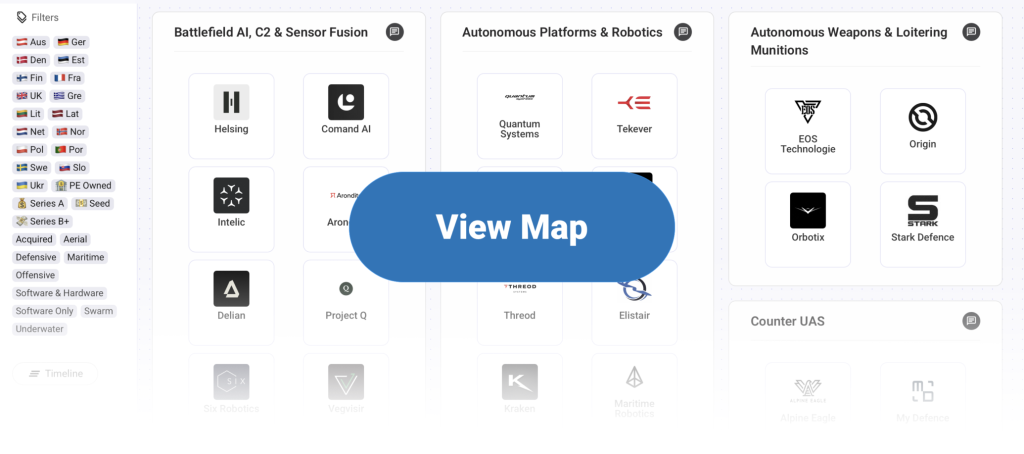
This post is part of a series covering the 🇪🇺 European defence startup landscape. You can view the full interactive map with more than 60 startups here.
What are defence autonomous drones and robotics?
Companies in this category build the “bodies” of modern defense: drones, ground robots, and autonomous vessels that carry out missions like surveillance, transport, or protection. These platforms are reusable, multi-mission, and designed for persistent presence (unlike “one way” drones used for attack).
Think of it as the military’s robot workforce: smart, mobile machines that stay in the field and do useful tasks again and again.
Example missions
- Long endurance aerial surveillance: drones that can stay airborne for many hours to monitor wide areas and detect movement or threats in real time.
- Autonomous cargo resupply: robotic aircraft or ground vehicles that deliver ammunition, food, or medical supplies without human pilots or drivers.
- Border patrol by ground robot: unmanned ground systems that move along borders or perimeters to spot intrusions and report back automatically.
- Maritime monitoring with USVs/UUVs: surface and underwater drones that track vessels, gather ocean data, or detect mines and submarines.
Typical products in this category:
- ISR drones: unmanned aircraft specialized in intelligence, surveillance, and reconnaissance missions.
- Maritime autonomy platforms: systems that enable boats and underwater vehicles to navigate, patrol, or collect data without onboard crews.
- VTOL UAVs: vertical take-off and landing drones able to operate from tight or mobile environments like ships or trucks
- UGVs: unmanned ground vehicles used for logistics, reconnaissance, or hazardous area inspection.
- Robotic sentries: stationary or mobile robots equipped with cameras and sensors to secure bases and restricted zones.
Why autonomous drones and robots are increasingly key for Europe
- The war in Ukraine has shown that modern conflict is dominated by autonomous, low cost drones that can overwhelm traditional equipment such as tanks and aircraft.
- The geopolitical landscape is changing defense priorities: as the US turns inward and China dominates drone manufacturing, Europe faces a growing need for technological sovereignty.
- Chinese firms now control much of the global supply chain for drone components and electronics, creating strategic dependence that many governments view as a national security risk.
- European defense startups are positioning themselves as alternatives, emphasizing domestic production, secure supply chains, and “China free” electronics in their designs.
- Many promote the fact that their drones are built with European hardware and software, reducing exposure to foreign components that could pose reliability or cybersecurity concerns.
- This shift is turning local autonomy in drone and robotics production from a technical advantage into a political and strategic selling point.
13 European Defence Startups Powering the Future of Autonomous Drones & Robotics
🇩🇪 Ger – 💸 Series B+
What they do:
- Builds long endurance and fixed wing VTOL drones for defense operations.
- Offers platforms like the Vector, Trinity Pro, and Scorpion for ISR (Intelligence Surveillance Reconnaissance).
How they differentiate:
- Specializes in transition drones that take off vertically and fly like airplanes, combining the best of quadcopters and fixed wing UAVs.
- Integrates edge AI capabilities for onboard data processing, target detection, and GNSS-denied autonomy.
- One of the few European drone makers with defense certification and NATO deployment, including use in Ukraine and by multiple NATO partners.
- Offers a platform first approach with robust payload interoperability rather than closed, mission specific systems
- Manufactures and develops in Germany, ensuring compliance with European defense and export regulations.

🇵🇹 Por – 💸 Series B+
What they do:
- Designs and builds fixed wing drones used mainly for surveillance, reconnaissance, and border control.
- Focuses on maritime and long range ISR missions with platforms like the AR3 and AR5.
- Provides integrated mission systems, including onboard AI, data links, and software for real time monitoring.
How they differentiate:
- Offers a complete drone ecosystem, not just hardware, including mission planning tools and analytics.
- Has a strong operational track record with European defense agencies, coast guards, and NATO partners.
- Known for rugged drones that perform well in challenging environments like open sea or remote borders.
- Combines in house flight platforms with payload flexibility and long endurance for practical field use.
🇩🇰 Den – 🏦 PE Owned
What they do:
- Builds tactical drones for defense, security, and disaster response missions.
- Their main platform, the Huginn X1D, is a quadcopter designed for close range ISR and field operations.
- Supports real-time imaging, thermal vision, and integration with C2 systems for fast situational awareness.
How they differentiate:
- Focused on reliability and simplicity in the field, making their drones easy to deploy with minimal training.
- Proven experience with defense forces and emergency responders, especially in rugged or high-stress environments
- Offers a practical, lightweight solution suited for frontline units needing “eyes on target” within minutes
- Based in Denmark, they position themselves as a trusted European supplier for tactical aerial surveillance.

🇬🇧 UK – 💵 Seed
What they do:
- Design and build uncrewed aerial systems used for defence, surveillance and inspection missions.
- Their drones can carry different payloads such as cameras, sensors or communication modules.
- Systems are made to operate in harsh weather and GPS-denied environments.
How they differentiate:
- Focus on rugged, battle-tested platforms proven in real operations.
- Modular design that lets users adapt drones to different missions.
- Strong feedback loop from field use, especially from Ukraine, allowing quick improvements.
- Emphasis on UK-made systems for trusted and secure supply chains.

🇪🇪 Est – 💵 Seed
What they do:
- Develop and manufacture unmanned aerial systems (UAS) including fixed-wing and VTOL (vertical take off and landing) drones for intelligence, surveillance and reconnaissance.
- Produce supporting subsystems such as electro optical payloads (gimbals), launchers and ground control systems.
- Serve military, government and defence customers in NATO and allied countries.
How they differentiate:
- Vertically integrated: they design air frame, payload, launch and control equipment internally for tighter system performance.
- Real world battle use: their systems are deployed in active operations (e.g., by Ukraine) which provides operational feedback.
- Flexibility and mission adaptability: their product lines include VTOL and fixed-wing formats plus interchangeable payloads for different mission profiles.
- Northern European design / supply-chain: being based in Estonia helps with trusted supplier status in NATO environments and allows agility compared with legacy defence contractors.

🇫🇷 Fra – 💵 Seed
What they do:
- Provide tethered drone systems: Drones connected to a ground station by a cable for persistent airborne surveillance, communications relay and industrial monitoring.
- Offer both dedicated tether drone boxes and tether stations that convert third-party drones into long endurance platforms.
How they differentiate:
- Their tether technology enables much longer flight durations than conventional drones by supplying power and data via the cable, reducing battery swap interruptions.
- They offer modular solutions compatible with various drone types and use cases.

🇬🇧 UK – Maritime
What they do:
- Develop uncrewed surface and subsurface maritime systems for defence and security, including autonomous vessels and modular payload platforms.
- Their product range includes platforms such as the “K3 SCOUT” USV, the “K4 MANTA” hybrid surface/sub-surface craft and the “K5 KRAKEN” precision engagement vessel.
- Manufacture at scale from a facility in the UK (“AREA 1”), capable of producing hundreds of unmanned maritime systems annually.
How they differentiate:
- Emphasis on modular, low-cost, production ready platforms rather than bespoke one off prototypes.
- Strong focus on maritime autonomy (surface and subsurface) at scale.
- Strategic partnerships and joint ventures (e.g., with NVL in Germany) to scale manufacturing and integrate into European defence supply chains.
- Already backed by sovereign and strategic investors (including the NATO Innovation Fund).
🇳🇴 Nor – 💸 Series B+
What they do:
- Develop uncrewed surface vessels and autonomous navigation systems for surveying, monitoring and defence operations.
- Provide turnkey solutions combining hardware, software and operational support.
- Operate from Norway with access to dedicated testing areas for autonomous vessels.
How they differentiate:
- Focus on reliable autonomy for maritime operations rather than traditional crewed vessels.
- Emphasise sustainability by lowering emissions and reducing the need for manned missions.
- Benefit from Norway’s strong maritime innovation ecosystem and testing infrastructure.

What they do:
🇪🇪 Est
- Build drones for frontline operators featuring jamming-resistant radios and the ability to fly without GNSS.
- Offer tactical ISR (intelligence, surveillance and reconnaissance) platforms and aerial target drones used by defence forces.
- Deliver solutions derived from real battlefield experience, including deployments in Ukraine and export contracts.
How they differentiate:
- Emphasis on resilience in contested environments with autonomous navigation for GNSS denied conditions.
- Blend hardware and software innovation to rapidly iterate based on feedback from actual operations.
- Based in Estonia, focus on defence grade, European-manufactured systems to avoid reliance on non-trusted supply chains.

🇺🇦 Ukr
What they do:
- Develop unmanned ground vehicles and robotic platforms for combat, logistics and support missions.
- Offer remote weapon stations, autonomous ground systems and situational awareness software.
- Provide hardware systems and supporting software solutions to defence customers.
How they differentiate:
- Combine hardware manufacturing of tactical robots with mission software and data systems in one integrated offer.
- Design equipment that has seen frontline use and is built to withstand harsh operational conditions.
- Based in Ukraine with a strong focus on rapid innovation and battlefield relevance.

🇩🇰 Den
What they do:
- Design and manufacture dones and autopilot units specifically for government, military and law enforcement users.
- Produce lightweight ISR drones and secure flight management systems made in the European Union.
- Source all critical components from trusted allied origins and focus on resilient autonomy in contested electronic warfare environments.
How they differentiate:
- Entirely EU owned and operated, with supply-chains built for sovereign defence standards.
- Develop in close collaboration with end-users and real-world operational feedback rather than only from lab prototypes.
- Emphasise autonomy and resilience to jamming and communications denial rather than relying solely on standard drone link methods.
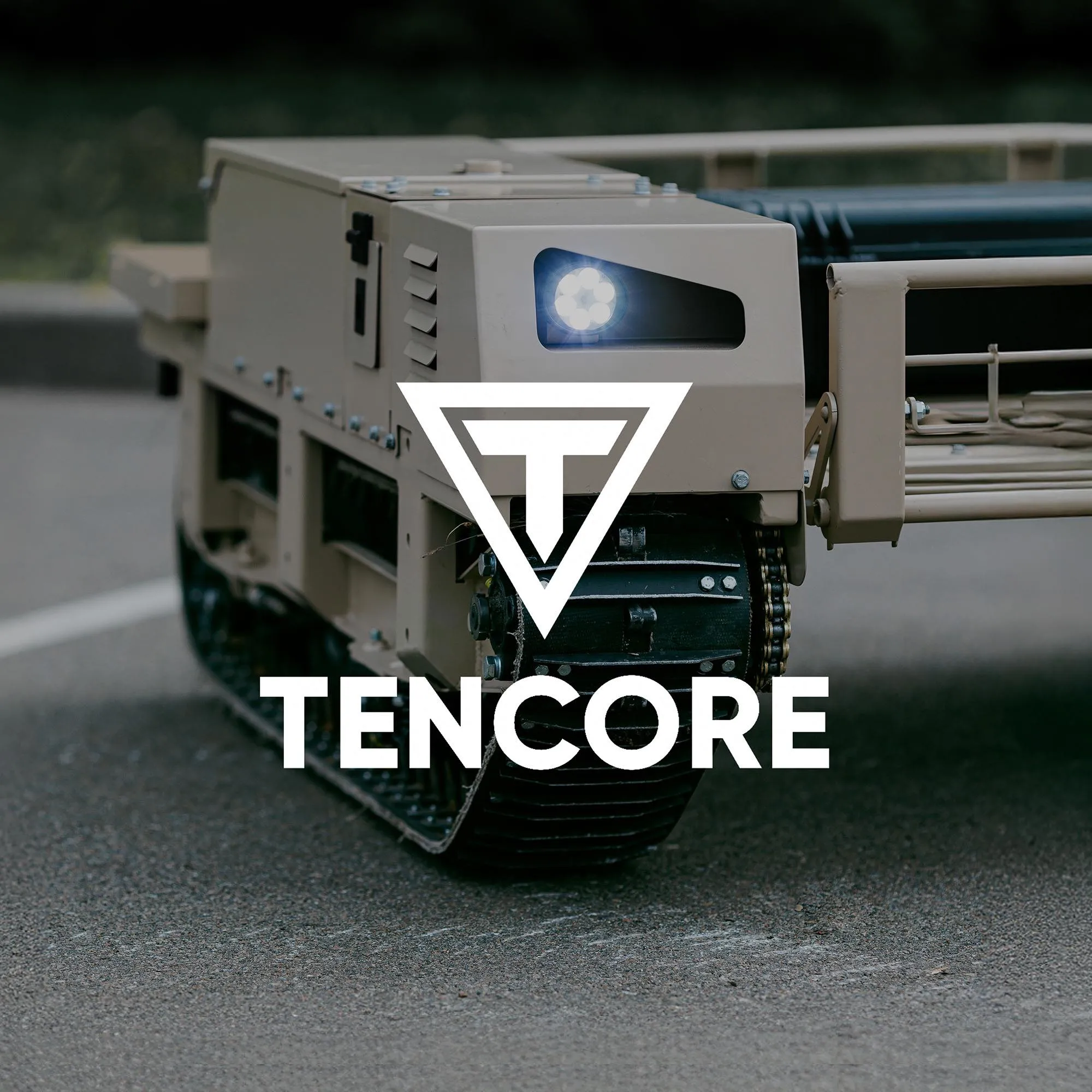
🇺🇦 Ukr – 💵 Seed
What they do:
- Build ground robotic systems that replace humans in high-risk tasks such as logistics, evacuation and engineering support.
- Their main platform, TerMIT, is a modular unmanned vehicle designed for transport, supply and frontline missions.
How they differentiate:
- Create modular robots that can switch quickly between roles such as logistics, demining or combat support.
- Design and test their systems in real battlefield conditions, ensuring reliability under extreme environments.
- Based in Ukraine, they combine fast iteration with scalable local manufacturing.

🇫🇷 Fra – 💵 Seed
What they do:
- Design and build small autonomous underwater vehicles that can operate for up to ten hours and dive to about 300 meters.
- Provide systems used for coastal surveillance, hydrography, mine counter measures and anti submarine training.
How they differentiate:
- Focus on compact and affordable underwater vehicles that are easier to deploy than large AUVs.
- Manufacture entirely in Europe and serve both civilian and defence markets with dual use technology.