
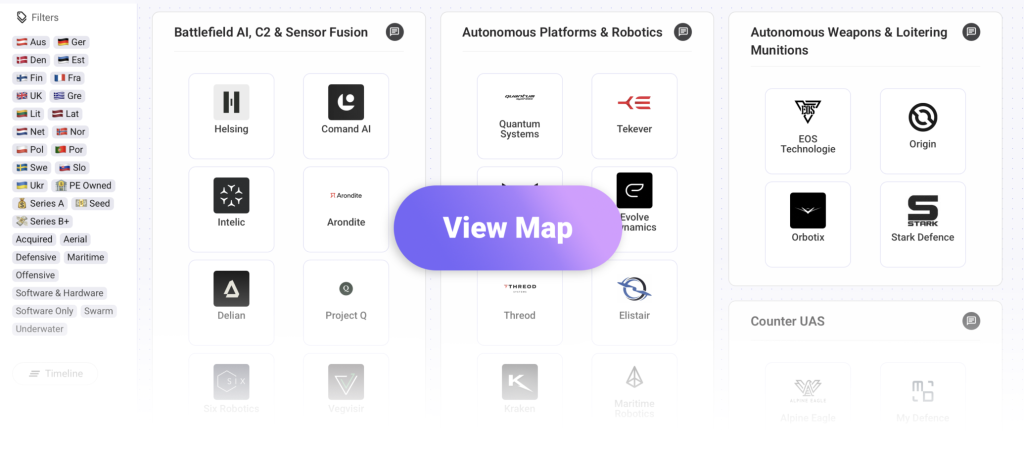
This post is part of a series covering the 🇪🇺 European defence startup landscape. You can view the full interactive map with more than 60 startups here.
What are drone enabling technologies?
This category includes startups that build critical components, subsystems, or software that power drone performance (without necessarily delivering a complete drone platform themselves).
Think of it as the infrastructure layer behind drone capabilities, the technologies that make autonomous systems smarter, faster, and more resilient.
These companies develop specialized capabilities such as:
- GPS denied navigation: Visual and inertial systems let drones find their position using cameras and motion sensors when GPS is jammed or spoofed. This is important because it makes drones resilient in contested environments and reduces reliance on vulnerable external signals.
- Onboard AI perception and autonomy: Tiny neural networks running on the vehicle let drones detect obstacles, classify targets, and make decisions without waiting for remote commands. This is important because it cuts latency, keeps operations possible when links are lost, and enables true autonomy in complex scenes.
- Flight control systems: Advanced control software combines adaptive algorithms and sensor fusion to keep aircraft stable under gusts, damage, or degraded sensors. This is useful because it allows safer, more aggressive maneuvers and tighter integration with autonomous behaviors.
- Edge processors and guidance stacks: Dedicated low power chips run guidance, perception, and mission logic on board rather than in the cloud. This is key because pushing compute to the edge unlocks heavier AI capabilities while preserving battery life and reducing exposure to network attacks.
- Swarming communication modules: Decentralized radio and mesh protocols allow many drones to share state and coordinate actions without a central controller. This is frontier because it enables distributed tactics that are robust to single point failures and that can overwhelm defenses through coordinated effects.
- Stabilized gimbals and imaging payloads: Compact stabilization and advanced sensors provide clear day and night imagery even from fast moving or vibrating platforms. This is important because better sensing in small packages turns low cost drones into high value intelligence and targeting assets.
- Specialized batteries and propulsion: New cell chemistries, hybrid power systems, and efficient propulsors extend flight time and increase payload capacity. This is key because longer endurance and greater range change what missions drones can perform and reduce dependency on logistics.
5 European Defence Startups providing Drone Enabling Technologies

🇩🇪 Ger – Acquired by Quantum Systems
What they do:
- Build AI software that gives drones and other unmanned systems the ability to see, navigate and make decisions on their own.
- Their technology allows safe and autonomous operation even without GPS.
- They work with defence and aerospace partners to deploy these systems in real missions.
How they differentiate:
- Focus on certified and safe autonomy for regulated sectors like defence and mobility.
- Their software runs on many types of hardware and sensors, making it easy to integrate.
- Strong track record of real world deployments through partnerships with defence companies.

🇸🇰 Slo – 💵 Seed
What they do:
- Develop open architecture autopilot and UAS platforms that enable AI-powered drones for defence, security and industrial uses.
- Offer hardware / Software ecosystems built around high performance modules from NVIDIA and other partners.
- Support systems optimized for both ISR applications and autonomous operations in contested or GNSS denied environments.
How they differentiate:
- Combine deep AI computing (Jetson-based) and drone hardware into integrated solutions that speed development and deployment.
- Provide modular platforms and adapters so users can build tailored drone systems rather than one size fits all.
- Operate as a trusted supplier with NATO and defence industry partners leveraging their scalable architecture.

🇪🇪 Est – 💵 Seed
What they do:
- Build autonomous navigation solutions that let drones fly without relying on satellite navigation or radio control.
- Focus on systems that work even in GPS or communications sedenied environments.
- Manufacture products in Estonia using European components and target defence use-cases.
How they differentiate:
- Offer navigation autonomy via computer vision and AI instead of conventional GNSS or radio links.
- Designed for lower cost and faster deployment than traditional military drone systems.
- Tailored to survive electronic warfare and jamming environments which challenge standard drones.

🇫🇷 Fra
What they do:
- Build low power edge AI systems based on neuromorphic computing for autonomous drones, satellites and defence platforms.
- Use event based sensors and spiking neural networks to enable fast perception and decision making with minimal energy use.
How they differentiate:
- Combine hardware and software design to deliver true on device autonomy instead of standard AI modules.
- Mimic biological neural systems to achieve very low latency and energy consumption.
- Focus on defence and aerospace missions where size, weight and power are critical.

🇺🇦 Ukr – 💰 Series A
What they do:
- Build AI-driven software that allows one operator to monitor and control a swarm of drones rather than one drone.
- Provide systems that enable drones to collaborate, navigate without GPS, and stream video securely in challenging environments.
How they differentiate:
- Focus on drone swarm autonomy rather than single drone operation.
- Offer modular software stacks that integrate combat tested algorithms and support large numbers of unmanned systems under one control.
- Designed with resilience for denied environments, electronic warfare and mission-critical defence tasks.