
This post is part of a series covering the 🇪🇺 European defence startup landscape. You can view the full interactive map with more than 60 startups here.
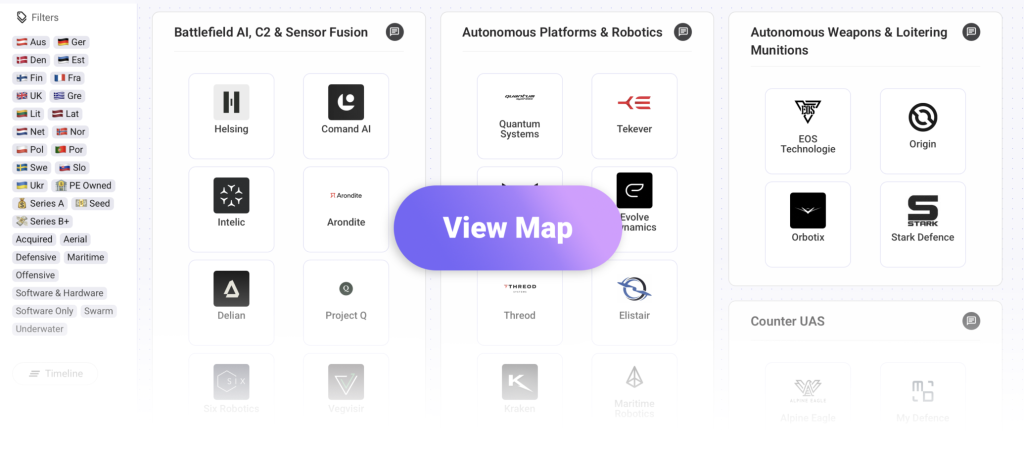
What are autonomous weapons & loitering munitions?
These startups build autonomous or semi-autonomous drones designed to strike. One way systems that fly to a target and explode, also known as loitering munitions or kamikaze drones. Unlike robotic platforms, they are single use weapons, designed to deliver destructive effects.
Think of it as the robotic bullet: it flies, thinks, and strikes, but doesn’t come back.
Example missions:
- Destroying enemy radar or vehicles
- Hitting mobile artillery or convoys
- Swarm attacks using coordinated strike drones
Typical products
- Strike swarm systems: groups of coordinated drones that share data and attack together to overwhelm defenses.
- Loitering drones : drones that can stay in the air for long periods, search for a target, and strike when one appears.
- One way attack UAVs: low cost drones designed for a single mission where they crash into the target and destroy it.
- AI-guided interceptors: autonomous drones that detect and pursue enemy UAVs to neutralize them in flight.
4 European Defence Startups Building Autonomous Weapons & Loitering Munitions

🇫🇷 Fra – 💵 Seed
What they do:
- Design and build fixed-wing drones for intelligence, surveillance and reconnaissance missions.
- Produce loitering munitions used for precision strike against hardened or armoured targets.
- Supply systems intended for rapid deployment and operational use by national defence forces.
How they differentiate:
- Offer French designed systems aimed at sovereign supply and reduced dependency on foreign gear.
- Emphasise endurance and fixed wing performance for tactical missions.
- Align product development with national defence procurement priorities for battlefield relevance.

🇱🇻 Lat – 💵 Seed
What they do:
- Design and build autonomous aerial systems for defence, including the BEAK man portable drone with strike capability.
- Develop the BLAZE autonomous interceptor for countering hostile drones.
- Focus on computer vision and AI to enable guidance and target detection in contested environments.
How they differentiate:
- Aim for low cost and mass producibility so forces can scale deployments.
- Prioritise practical battlefield feedback to keep designs simple and effective.
- Build autonomy and jamming resilience into guidance so systems work when GPS or comms are degraded.

🇵🇱 Pol – Seed
What they do:
- Build autonomous one way attack drones designed for precision strike missions.
- Develop AI driven surveillance software that links to cameras and drones for real-time threat detection.
- Offer a drone-in-a-box system that supports rapid deployment and automated recharging for continuous operations.
How they differentiate:
- Emphasise autonomous target acquisition so systems can identify and engage with limited operator training.
- Design for contested environments with features for night operations, swarm deployment and jamming resilience.
- Combine hardware and AI software to deliver end-to-end surveillance and strike capabilities that integrate with existing systems.

🇩🇪 Ger – 💸 Series B+
What they do:
- Build loitering munitions capable of vertical take-off and autonomous strike missions.
- Develop mission control software that links unmanned systems across land, air and sea for coordinated operations.
- Support NATO and European forces with rapidly deployable strike systems aligned to modern battlefield needs.
How they differentiate:
- Emphasise mass-produced strike drones rather than bespoke high cost missiles.
- Integrate autonomy and mission software (for example in GPS-denied environments) into their unmanned systems.
- Combine defence grade hardware with scale and speed of production to meet urgent European requirements.