
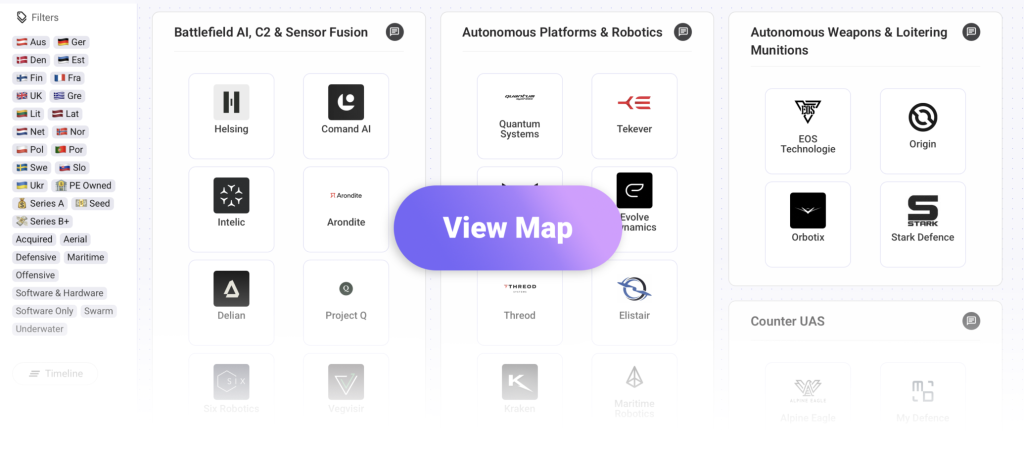
This post is part of a series covering the 🇪🇺 European defence startup landscape. You can view the full interactive map with more than 60 startups here.
What is demining & explosive threat detection?
Companies in this category deliver a mix of robotics, drone systems, sensor payloads, and AI software that allow operators to detect and localize buried explosives with greater accuracy and less human risk. Some provide autonomous systems to assist with clearance, while others specialize in high resolution mapping or remote detection from the air.
How mine detection works:
Modern mine detection is increasingly done with a multi sensor approach, often using:
- Drones (UAVs): equipped with optical cameras, multispectral sensors, or radar to scan wide areas safely from above.
- Ground-penetrating radar (GPR): emits radio waves into the ground to detect changes in material, shape, or buried objects
- Magnetometers and metal detectors: used to identify metal-cased mines or components in UXO.
- Thermal imaging: detects temperature anomalies caused by disturbed soil or hidden devices.
- AI-based analysis: algorithms process sensor data to highlight probable mine locations and reduce false positives.
- UGVs (ground robots): used for close in detection or vegetation clearing before human teams move in
4 European companies providing demining & explosive threat detection

🇱🇹 Lit – 💵 Seed
What they do:
- Develop airborne radar and AI-based systems that detect underground objects such as landmines from a distance.
- Deliver subsurface imaging platforms mounted on drones to support demining and clearance operations.
How they differentiate:
- Their solution provides 3D visualisation of buried threats, which improves accuracy compared with traditional metal-detectors.
- They focus specifically on mine and unexploded-ordnance detection rather than broader defence sensors.
- Based in Lithuania, they target conflict zones and high-risk regions where landmine clearance is urgent.
🇳🇱 Net
What they do:
- Develop drone systems that map and identify areas contaminated by landmines and unexploded ordnance.
- Support humanitarian and defence teams by providing aerial data to plan and execute safe clearance operations.
How they differentiate:
- Combine drones and cloud based mapping to speed up mine detection compared to manual methods.
- Focus on cost effective and scalable solutions to survey large areas while reducing risks for deminers.
- They operate mainly as a humanitarian technology organisation.

🇩🇪 Ger
What they do:
- Build a drone based sensor system for detecting land mines and unexploded ordnance using radar and UAVs.
- Support mine action teams by shortening survey time and enabling land release in contaminated areas.
How they differentiate:
- Focus on mine detection rather than general UAV surveillance, using ground-penetrating radar mounted on drones.
- Translate research prototypes into practical products for humanitarian and defence use.
- Operate as a non-profit startup committed to efficiency and affordability in mine action technology.
- They are supported by the Urs Endress Foundation and other grants.
🇫🇷 Fra
What they do:
- Develop underwater acoustics and robotics solutions for mine-counter measure operations using diver-held sonars, autonomous underwater vehicles and positioning beacons.
- Help navies recreate full manned and unmanned mine-warfare environments for detection, classification and neutralisation of underwater threats.
How they differentiate
- Focus specifically on underwater mine counter-measures rather than broader maritime equipment.
- Combine acoustic signal processing and modular AUV systems to cover detection and navigation in complex underwater environments.
- Deliver systems used by navies around the world and built to rigorous defence standards.