
This post is part of a series covering AI fake & fraud detection startups. You can view the full competitive landscape with more than 35 startups here.
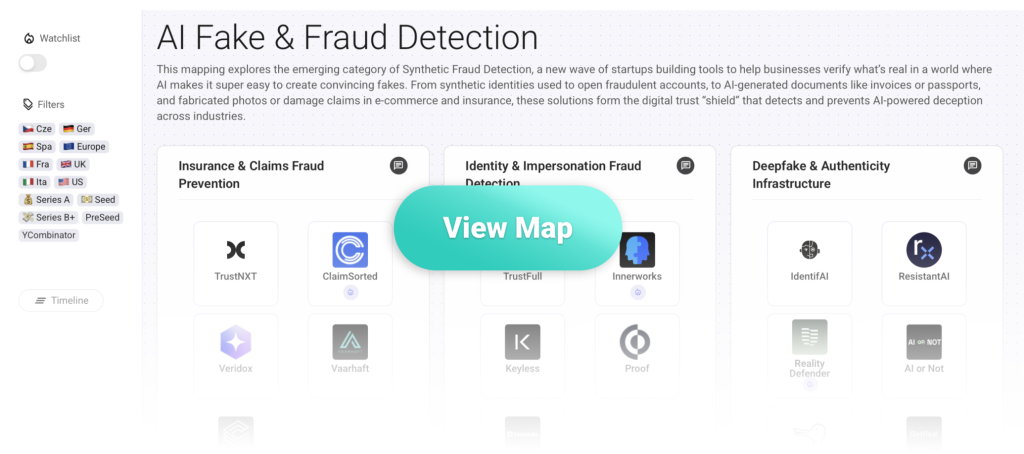
This competitive mapping explores the emerging category of Synthetic Fraud Detection, a new wave of startups building tools to help businesses verify what’s real in a world where AI makes it super easy to create convincing fakes. From synthetic identities used to open fraudulent accounts, to AI-generated documents like invoices or passports, and fabricated photos or damage claims in e-commerce and insurance, these solutions form the digital trust “shield” that detects and prevents AI-powered deception across industries.
What are AI deepFake & Fraud Infrastructure startups?
Rather than selling directly to end users, these startups play the classic picks-and-shovels role of the synthetic fraud ecosystem a.k.a providing the core infrastructure that others build upon.
Their APIs and SDKs let banks, insurers, marketplaces, and media platforms embed deepfake detection and content authenticity checks directly into their own products.
Much like Stripe did for payments or Twilio for communications.
11 Startups Providing AI DeepFake & Fraud Infrastructure

🇪🇺 Europe – 🇮🇹 Ita
What they do:
They provide a deep-fake detection and content authenticity platform that examines images, videos and voices to determine whether content was generated or manipulated by AI.
How they differentiate:
Their system uses what they call “de-generative” models (probabilistic pixel-pattern analysis rather than semantic analysis) and claims ~94% detection accuracy; strong emphasis on disinformation, media surveillance and law-enforcement use.

🇨🇿 Cze – 🇪🇺 Europe – 💸 Series B+
What they do:
They offer document fraud detection and transaction monitoring models designed for financial institutions, able to detect forged documents, synthetic identities, abnormal transaction patterns and other forms of fin-crime.
How they differentiate:
They focus on “bolt-on” AI models for existing financial workflows (onboarding, AML, KYC) that claim major gains (e.g., ~3× more fraud detected, 90% automation) without replacing the core tech stack.

🇺🇸 US – 💰 Series A
What they do:
They provide an API/SDK for developers to embed deepfake detection of images, audio, video (and now text) into their applications, targeting fraud, identity verification, content moderation, disinformation.
How they differentiate:
Developer friendly, “two lines of code” integration, free tier (e.g., 50 scans/month) and multimodal detection across image/audio/video/text, positioning themselves as trust infrastructure for many use-cases.
🇺🇸 US – 💵 Seed
What they do:
Offer a detection platform/API that identifies AI-generated content (images, audio, deepfakes, text) to support fraud detection, identity verification and content authenticity.
How they differentiate:
Claims high accuracy and positions itself as a lightweight tool for business and individuals to add AI content detection capability without heavy infrastructure.

What they do:
Tell If AI offers an API and SDK platform for detecting whether images, video or audio were generated or manipulated by AI i.e., identifying deepfakes and synthetic-media content.
Main differentiation:
Their team, founded by ex-researchers from DeepMind and Yandex, has trained proprietary foundation models on data from 70+ generative AI systems and claim high precision/recall along with the ability in some cases to even identify which generative model produced the content.

🇺🇸 US
What they do:
GetReal Security offers an enterprise grade platform for detecting and mitigating deepfake and synthetic media threats, covering real-time video/voice impersonation, image and audio forensics, and continuous identity protection during digital communications (e.g., video conferencing).
How they differentiate:
Unlike simple detection tools, it continuously monitors live video and voice sessions for manipulation, helping companies stop deepfake impersonation as it happens.
🇺🇸 US – 💰 Series A
What they do:
Polygraf AI offers an on-premise AI security platform designed to detect synthetic content (deepfakes, manipulated media, AI-generated texts), protect sensitive data, and govern AI usage across enterprise systems.
How they differentiate:
Unlike cloud only tools, Polygraf runs in customer controlled environments (on-prem or zero-trust setups) and claims high accuracy in detecting AI-generated or manipulated content across many formats (text, voice, video) and heavy compliance/regulation settings.

🇺🇸 US
What they do:
Scam.ai provides an API that lets organisations verify videos, voices and messages in seconds to detect AI-powered scams.
How they differentiate:
They focus on making deep-fake/voice-clone detection accessible and fast for non technical users, emphasising ease of use (“no tech degree required”).

🇺🇸 US
What they do:
SWEAR provides a platform that generates a cryptographic “proof-of‐original” at the moment video (and other media) is captured, so that the authenticity of that footage can later be verified.
How they differentiate:
Unlike tools that try to detect fakes after the fact, SWEAR locks in evidence of authenticity at capture time so you can definitively say “this recording is real” rather than guess.

🇺🇸 US
Open-Source AI-generated image/deepfake detection.
🇺🇸 US – 💰 Series A
What they do:
Resemble AI offers a voice synthesis platform that enables users to create realistic AI-generated speech and voice clones through text-to-speech and speech-to-speech APIs. They also offer deepfake detection APIs
How they differentiate:
They embed inaudible watermarks into synthetic audio using their proprietary PerTh technology, allowing content authenticity to be verified.