This post is part of a series covering AI fake & fraud detection startups. You can view the full competitive landscape with more than 35 startups here.
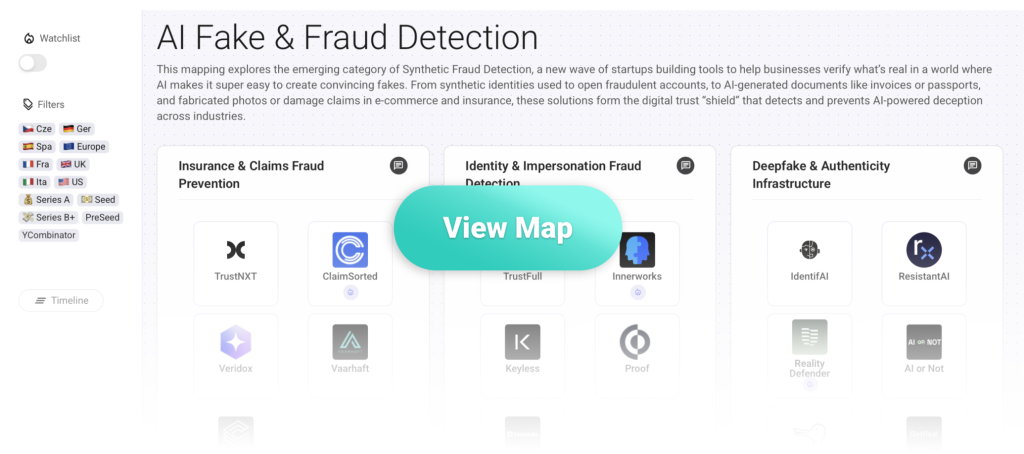
This competitive mapping explores the emerging category of Synthetic Fraud Detection, a new wave of startups building tools to help businesses verify what’s real in a world where AI makes it super easy to create convincing fakes. From synthetic identities used to open fraudulent accounts, to AI-generated documents like invoices or passports, and fabricated photos or damage claims in e-commerce and insurance, these solutions form the digital trust “shield” that detects and prevents AI-powered deception across industries.
What issues are create by GenAI in text integrity and authorship?
- Generative AI tools now produce essays, research papers, and grant proposals that read as human writing. Authorship is increasingly harder to verify.
- Traditional plagiarism detectors fail because AI-generated text is “original”, most of the times not direct copies.
- The rise of AI written academic and professional work undermines trust in originality which can be an issue (see the scandal that Deloitte faced after using GenAI for a $400k report…).
- Institutions face new ethical and administrative challenges as they struggle to distinguish genuine human work from synthetic output (real philosophical question).
What are the major approaches used by startups to counter it?
- Analyzing linguistic and stylistic patterns: Sentence rhythm, vocabulary entropy, and structure to detect AI produced texts.
- Leveraging statistics, comparing a text’s word usage probabilities or complexity against known AI generation profiles.
- Monitoring typing dynamics and writing behavior, tracking how text is produced rather than just what it says.
- Embedding invisible watermarks or cryptographic signatures in AI outputs to prove provenance when possible.
3 Startups Tackling AI Text Integrity & Authorship Verification

🇺🇸 US – 💵 Seed
What they do:
They offer an AI text detection platform that analyses text to determine whether it was human written or generated by a large language model and even identifies which LLM (like ChatGPT, Gemini, Claude) may have been used.
What makes them different:
They emphasise extremely high accuracy and a very low false positive rate (they claim false positives as low as 1 in 10,000) by training on “hard negative” cases and continuously updating for new LLMs.
🇺🇸 US – 💵 Seed
What they do:
They offer a platform that detects plagiarism and checks whether text (and even code) is original or derived from other sources.
What makes them different:
Traditional plagiarism tools mostly match exact text or phrases but Copyleaks uses machine-learning / NLP to understand writing style, semantics and detect paraphrasing or AI-generated content.
They also support a full workflow (educational institutions, business publishers) with integrations in popular platforms, and cover both text and code authenticity (not just standard document plagiarism).
🇺🇸 US – 💰 Series A
What they do:
They provide a tool that detects whether a given text was likely written by a human or generated by a large language model (AI).
GPTZero began as a winter-break senior thesis project by a Princeton undergrad, who built the initial version and released it online in January 2023.
What makes them different:
They use metrics like perplexity (how predictable the text is to a language model) and burstiness (variation of sentence structure) instead of only surface matching phrases.