
This post is part of a series covering AI fake & fraud detection startups. You can view the full competitive landscape with more than 35 startups here.
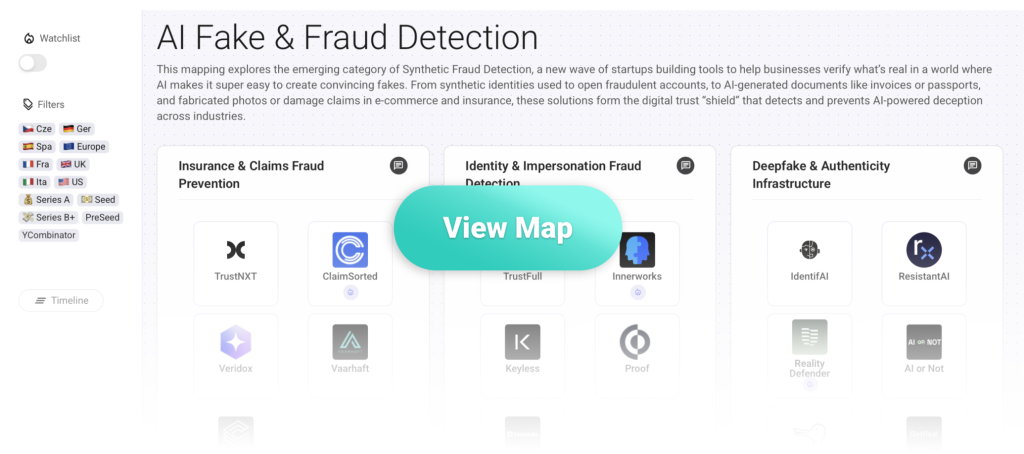
This competitive mapping explores the emerging category of Synthetic Fraud Detection, a new wave of startups building tools to help businesses verify what’s real in a world where AI makes it super easy to create convincing fakes. From synthetic identities used to open fraudulent accounts, to AI-generated documents like invoices or passports, and fabricated photos or damage claims in e-commerce and insurance, these solutions form the digital trust “shield” that detects and prevents AI-powered deception across industries.
What challenges does GenAI pose for content provenance and authenticity?
- As AI-generated content floods the web, it’s becoming nearly impossible to tell what’s human made and what’s synthetic.
- Edited or reposted media quickly loses its original metadata, breaking the chain of attribution.
- Without a reliable way to trace origin, trust in digital content is eroding across media platforms.
- The absence of universal standards makes interoperability and enforcement difficult.
Major approaches used by startups to counter it:
- Embedding invisible watermarks within pixels, frames, or audio waveforms to tag the origin of AI-generated content.
- Using cryptographic provenance tags or hashes that persist even after compression, helping trace how and where content was created.
- Developing verification layers that allow downstream platforms and regulators to automatically check authenticity at scale.
- Partnering with AI model providers and content platforms to standardize watermark embedding during generation.
3 startups providing invisible watermarking & AI provenance tags

What they do:
They offer a API based invisible forensic watermarking on images, videos and documents. Its deep-learning steganography embeds provenance “invisibly” (like a hidden QR code) into each asset without altering visible quality
How they differentiate:
The system is designed to survive common edits and trace leaks back to their source, and it emphasizes “state-of-the-art photographic steganography and forensic watermarking” as its core technology.

🇪🇺 Europe – PreSeed
What they do:
They provide developer centric SDKs and REST APIs for embedding invisible IDs into images, audio, and video.
How they differentiate:
DeepMark’s AI-driven watermarking reportedly “packs rich metadata into minimal space” and is “highly resistant to attacks” including AI manipulations.

🇪🇺 Europe – 🇫🇷 Fra
What they do:
Hado provides invisible watermarking for AI-generated images and videos, embedding imperceptible provenance signals to trace the origin of synthetic media.
How they differentiate:
Their watermarking is designed to be tamper resistant yet visually undetectable, and remains intact across common image transformations.