
This post is part of a series covering the AI receptionist market. You can view the full interactive competitive landscape with more than 70 startups here.
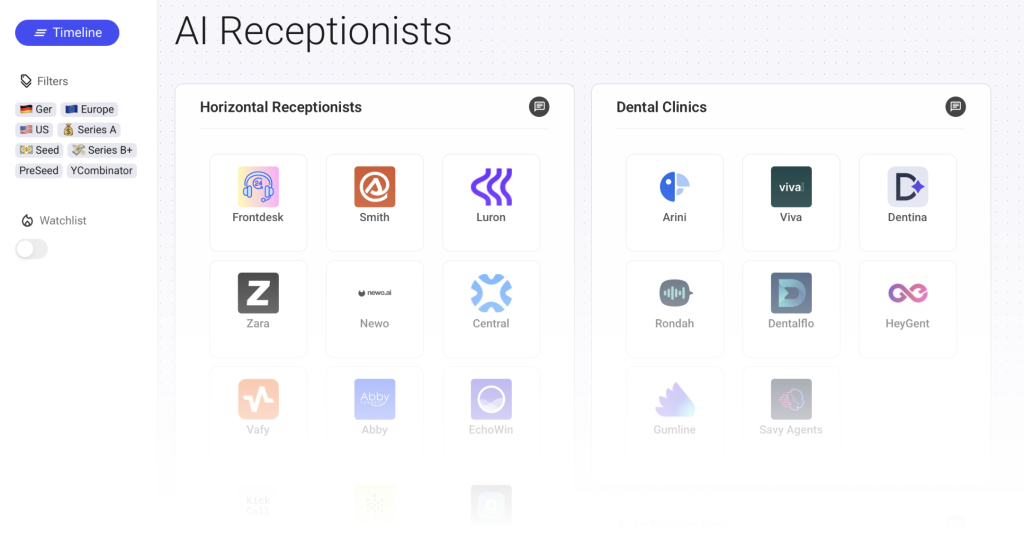
This map covers the emerging (and already competitive) landscape of AI receptionists startups powered by GenAI that autonomously answer inbound
9 Insights from building the AI receptionist market landscape
- #1 The core functions of AI receptionists. First of all, the common core functions across all startups listed are to autonomously answer inbound calls, book, route, or screen them, and integrate with calendars and CRMs. On top of that, each product adds a variation of extra features or functions tailored to the verticals they target.
- #2 Who’s going to win: vertical or horizontal AI receptionists? There’s a tension between horizontal platforms that enable any type of business to deploy an AI receptionist, and verticalized ones that specialize in specific industries. To answer this question, I think you need to look at three key dimensions:
- Is your receptionist a cost or a revenue center?
- Who, in the business, is traditionally answering the calls?
- What is the depth of the post-call actions?
- #3 Is your receptionist a cost or a revenue center? The first dimension to assess is whether inbound calls can lead to additional revenue or not. For instance, most calls received by doctor practices come from existing patients (and they’re often already fully booked). Whereas in a car dealership, a large portion of calls come from new customers who are actively looking to buy, making the receptionist more of a revenue enabler.
- #4 Who, in the business, is traditionally answering the calls? The second dimension is about who normally handles the calls. In some cases, it’s a dedicated receptionist (like in doctor practices), while in others, it’s a worker or even the owner (like a plumber or a contractor). So the perceived value, and the potential friction to adopt an AI solution, isn’t the same.
- #5 What is the depth of the post-call actions? The last dimension to examine is how deep the follow-up actions go. For home services, it’s often quite light: once the customer books an appointment and the data is added to the CRM or calendar, the main follow-up is usually a reminder. But in other verticals, like financial services, there can be compliance and contract-related workflows to manage. Or in healthcare, post-call actions might involve health insurance coordination or patient data handling.
- #6 So, does verticalization make sense? You need to evaluate each vertical along the three dimensions above. For example, I think some verticals (like many home services) can be addressed well enough by generalist AI receptionist platforms, whereas others (like healthcare, legal, or financial services) clearly benefit from deeper vertical specialization. As usual, I might be wrong on this one.
- #7 Are AI receptionists a trend or a fad? I have no doubt it’s a trend and not a fad. First, many industries are facing a shortage of human receptionists. Second, weak population growth (or in many countries, decline) won’t improve that. And third, I bet most people would rather interact with an intelligent bot than with a human for these types of tasks (basic questions, setting meetings etc…). I think we underestimate how much social anxiety drives user preference here.
- #8 A majority of bootstrapped / pre-seed startups. There are a couple of startups that have raised more than $10M – $15M but only in some categories (Auto dealerships, healthcare and infrastructure players). The vast majority are unfunded / pre-seed companies. Raising money with an AI receptionist is tough because there are low entry barriers in terms of tech and the real moat is sales execution (atm at least).
- #9 But the AI receptionist graveyard will probably be full in 18–24 months. TBH I was quite surprised to find so many AI receptionist startups, and I’m sure I haven’t found them all. Of course, quality varies widely, but regardless, there will simply be too many of them and probably not differentiated enough. Let’s check this map again in 12-18 months to see how the graveyard will look.