
This post is part of a series covering the AI receptionist market. You can view the full interactive competitive landscape with more than 70 startups here.
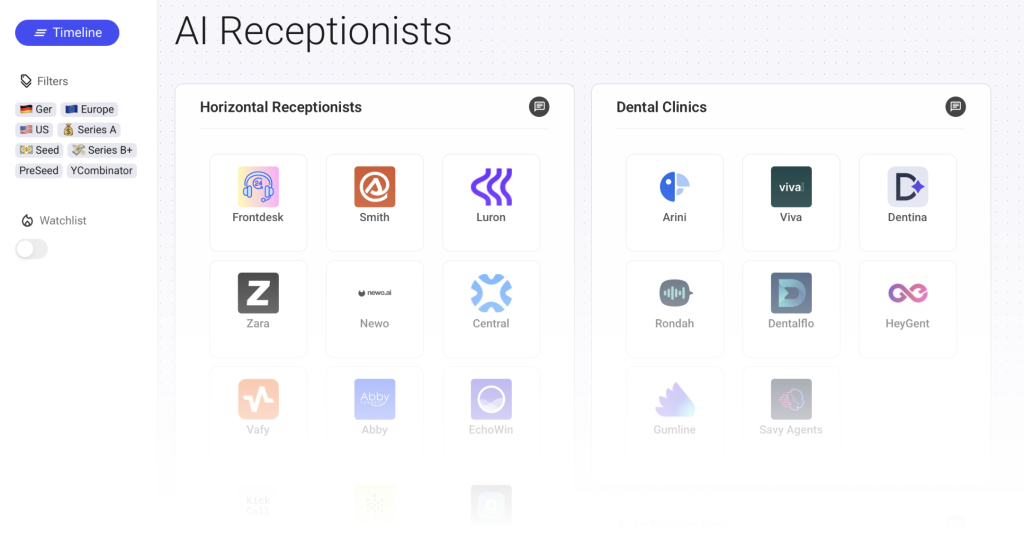
This map covers the emerging (and already competitive) landscape of AI receptionists startups powered by GenAI that autonomously answer inbound calls, book, route, or screen them, and integrate with calendars and CRMs. These products act as always on voice agents for businesses that depend on phone interactions to capture leads or serve customers.
Hospitality Businesses (Restaurants, Hotels…)
Hospitality businesses (from restaurants and cafés to hotels and resorts) rely heavily on phone interactions for bookings, inquiries, and customer service. AI receptionists in this sector focus on automating reservations, order intake, and guest requests.
Some of their value propositions is to reduce missed calls during peak hours, provide 24/7 coverage, answer FAQs, and route more complex inquiries to human staff. Another benefit can be multilingual support since these types of businesses deal with more diverse customers.
Is the receptionist a cost or a revenue center?
In hospitality, the receptionist is definitely a revenue enabler. Calls often come from new or returning customers looking to make reservations, book rooms, or place orders, all of which translate directly into revenue. Quick, frictionless responses directly impact booking volume and customer satisfaction.
Who, in the business, is traditionally answering the calls?
It varies by size: larger hotels and restaurants often have dedicated front-of-house staff, while smaller establishments might have servers, managers, or even owners picking up. Because missed calls can mean missed bookings, AI receptionists are attractive for both reducing workload and capturing revenue more reliably.
What is the depth of the post-call actions?
The follow-up actions are usually light to moderate. Once a reservation or order is confirmed and logged into the booking system or POS, the workflow is largely complete. In hotels, there might be additional CRM integration for guest preferences or upselling, but complexity is lower than in regulated industries.
7 Startups Offering AI Receptionists for Restaurants & Hospitality Businesses
💵 Seed
What they do:
- The product is an AI phone agent that answers calls for restaurants and handles reservations, orders, and guest questions. It works around the clock and reduces missed calls by taking over routine interactions.
- The system takes pickup and delivery orders. It processes payments securely and sends everything directly into the restaurant’s POS so staff do not need to re enter information.
- The software manages reservations and guest inquiries. It gives information on hours, menu items, wait times, directions, and supports multilingual callers.
- A dashboard shows live calls, transcripts, outcomes, and lets owners update menus, hours, and specials. It also provides analytics on missed calls and peak times.
Company specificities:
- The company emphasises very fast onboarding. Most restaurants can go live within a day with menu import and simple configuration.
- Their integrations with major restaurant tech systems make order flow and reservation management automatic and smooth.
- The platform works for single locations as well as large chains.
- Their positioning focuses on both revenue capture and labour relief. Fewer missed calls mean more bookings, while frontline teams face less overload during peak hours.

PreSeed
What they do:
- The product functions as a 24 hour AI phone receptionist for restaurants and hospitality businesses. It answers inbound calls and captures reservations, orders and guest inquiries.
- The software manages table availability in real time. It books or modifies reservations and syncs with the venue’s reservation system for instant confirmation.
- It supports phone based pickup and delivery ordering and can push orders directly into the POS or online ordering system.
- A dashboard provides call recordings, transcripts and analytics. Businesses can update menus, hours and details so callers always receive accurate information.
Company specificities:
- The AI has been trained on a large volume of hospitality calls which gives it strong domain understanding and natural handling of guest style questions.
- The product offers native reservation system integrations that allow full booking workflows through the voice agent.
- Setup is simple as it works with the restaurant’s existing phone system. Forwarding the number is usually enough to go live quickly.
- It serves both small restaurants and multi unit groups by allowing each location to customise settings while keeping analytics centralised.

PreSeed
What they do:
- The software provides an AI receptionist that answers calls around the clock for restaurants, cafés and hotels. It captures reservations, waitlist requests and routine guest inquiries.
- It responds to common questions about hours, menus, location and booking changes. More complex issues can be routed to human staff.
- The product recognises returning guests and adapts to the venue’s tone of voice to create a consistent and personalised caller experience.
- A central platform lets businesses update hours, menus and services, while also tracking missed calls and analysing call patterns to reduce lost bookings.
Company specificities:
- The AI is designed specifically for hospitality interactions, giving it strong understanding of restaurant and hotel caller needs.
- The company offers the AI receptionist as part of a wider plug and play suite that also includes menu tools, inventory features and marketing automation.
- It serves both single venues and multi unit groups through local customisation of greetings and menus while keeping analytics centralised.
- The positioning focuses on revenue generation by reducing missed bookings and delivering a smoother guest experience that encourages repeat visits.

PreSeed
What they do:
- The product is an AI host for restaurants and hotels that answers every call at any time of day. It turns missed calls into bookings and guest interactions.
- The software handles reservations and orders. It can accept, modify or cancel bookings and it helps reduce no shows by supporting deposit collection.
- It integrates with reservation systems, POS platforms and existing phone infrastructure so operations remain synchronised.
- A dashboard provides analytics, transcripts and call summaries. Staff gain more time for in person guest service instead of routine phone duties.
Company specificities:
- The company focuses strongly on full call coverage, ensuring that every incoming call is answered to prevent lost bookings.
- They offer broad hospitality system integrations that allow smooth booking flows through conversational voice.
- Deployment is designed to be fast and simple so venues can activate the service without heavy onboarding.
- Their positioning targets both revenue generation and staff relief by combining higher booking capture with reduced phone workload.

💵 Seed – YCombinator
What they do:
- The product is an AI voice agent built for hotels. It answers calls at any time and handles guest inquiries and reservations without human intervention.
- Guests can use it to order in room dining or request hotel services through a natural voice conversation. This reduces the need for staff involvement in routine tasks.
- It supports multiple languages so international guests can communicate easily and get the information they need.
- A dashboard gives hotels visibility on call activity, transcripts and performance. Staff can focus on in person service instead of constant phone handling.
Company specificities:
- The company focuses on seamless integration with hotel systems such as property management, reservations and phone infrastructure so deployment is smooth.
- Their voice models are trained specifically for hotel scenarios and are customised per location which improves accuracy and guest experience.
- The solution aims to increase revenue by capturing more calls and converting them into bookings while also reducing operational workload.
- It is designed to handle high call volume with instant pickup which helps hotels avoid lost reservations and guest frustration.
💰 Series A
What they do:
- The product is a voice AI assistant designed for restaurants. It answers inbound calls at any time of day and handles guest questions and reservations.
- The system can book, modify or cancel reservations automatically through connections with major reservation platforms.
- It responds to routine inquiries such as hours, menu information and directions which frees staff for in person guest service.
- A dashboard shows call activity, bookings created, caller satisfaction and missed opportunities so operators can optimise their operations.
Company specificities:
- The company focuses entirely on restaurants which means the voice AI is built specifically for dining-related workflows.
- Its strong integration ecosystem with reservation systems enables full booking workflows directly from a phone call.
- They highlight high caller satisfaction and a large share of fully automated calls which reinforces the reliability of the product.
- The platform is designed for multi venue operations and can manage high call volumes while also covering after hours calls.
PreSeed
What they do
- The product is an AI voice host for restaurants that answers calls at any time and helps reduce missed reservations and orders.
- It connects with reservation systems so bookings and modifications sync smoothly with the restaurant’s existing tools.
- The software supports to go and delivery orders and can send SMS links for mobile ordering which reduces pressure on phone staff.
- It offers multilingual support and can use brand specific voice profiles so the AI feels aligned with the restaurant’s identity.
Company specificities:
- The company focuses on restaurant chains and adapts the product to each brand with customised voice profiles and operational settings.
- Strong integrations with POS systems, online ordering platforms and reservation software make it easy to fit into an existing tech stack.
- Their plans are structured per location with higher tiers offering deeper customisation and enterprise level support.
- The positioning emphasises revenue capture by answering more calls and improving guest conversion while also reducing labour needs.