
This post is part of a series covering the unbundling of physical inspection. You can view the full interactive map with more than 40 startups here.
The Unbundling of Physical Inspection
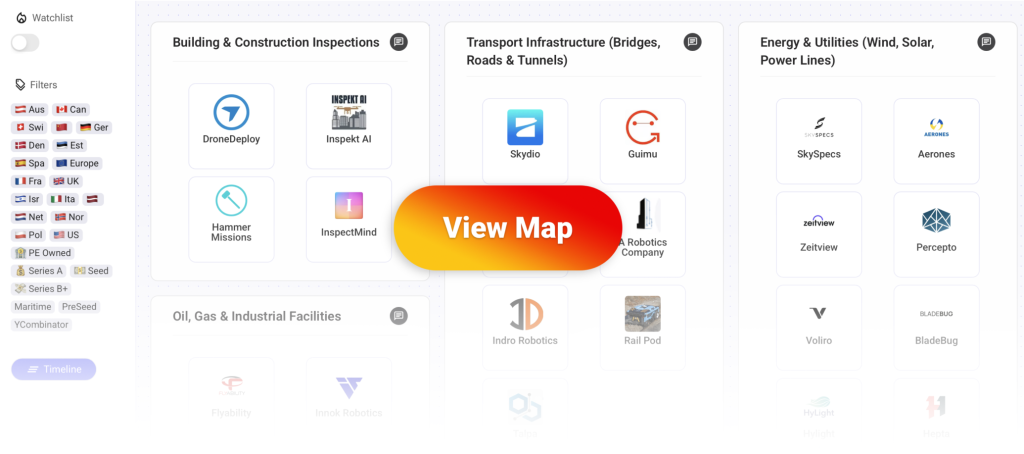
In many industries, inspections have traditionally been carried out by human inspectors checking for defects, damage, or maintenance needs. Today, advances in robotics, drones, and AI are unbundling these tasks and automating physical inspections (often still under human supervision). The competitive landscape above is an overview of major categories of physical inspections and companies automating these processes.
Vehicle Inspection
How inspection is traditionally done:
- Human inspectors walk around vehicles to visually assess exterior and interior condition, checking for dents, scratches, and fluid leaks.
- In the automotive industry, inspections are performed manually during rental returns, fleet maintenance, or resale evaluations.
- Aviation maintenance crews conduct detailed pre-flight and post-flight visual checks using ladders, flashlights, and checklists.
- Documentation is manual and subjective which can lead to inconsistent results and potential oversight of minor defects.
How AI and robotics are changing it:
- Computer vision models analyze photos or video captured by smartphones, fixed cameras, or scanning booths to detect damage automatically.
- AI systems quantify defects such as scratches, dents, or tire wear and generate standardized condition reports.
- Drones autonomously inspect aircraft exteriors, capturing detailed imagery far faster and safer than human crews.
- Integrated inspection platforms centralize image data and analytics, improving accuracy, traceability, and turnaround time across fleets or airports.
7 Startups Automating Vehicle Inspection

🇪🇺 Europe – 🇫🇷 Fra – 💵 Seed
What they do:
- They enable quality inspection of used and rental vehicles by using AI and computer vision to detect body damage, interior issues, tyre and rim condition, and to read vehicle data like mileage and VIN.
- Their platform is used by dealerships, rental companies, fleet operators, insurers and marketplaces to speed-up vehicle inspections, improve consistency and reduce manual effort.
- They deliver software that checks image quality (blur, angle, light), ensures standardized photo capture, then analyses the images to produce damage reports, condition scores and repair cost estimates.
- The major value lies in lowering costs of inspections, increasing throughput, reducing disputes over vehicle condition and enabling faster remarketing or trade in decisions.
Company specificities:
- They have developed a proprietary AI engine that works with minimal hardware change and integrates into mobile devices or vehicle photo workflows, which means clients can adopt it without entirely rewiring inspection setups.
- They support both remote inspection workflows (vehicle photographed off site) and on-site workflows (dealership or rental return) which offers flexibility across vehicle lifecycle scenarios.
- They go beyond simple defect detection by providing standardized image capture guidance, photo quality checks and automatic cost estimation, so the system covers both inspection and business processes.

🇪🇺 Europe – 🇫🇷 Fra – 💵 Seed
What they do:
- They enable inspection of aircraft external surfaces. Their system uses autonomous drones to inspect aircraft fuselages, engines and landing gear components.
- Their solution is used by airlines, aircraft maintenance organisations and OEMs who need to detect damage, paint defects, lightning strike marks and structural irregularities.
- The drones collect high-resolution images and the software analyses them using computer vision to generate inspection reports, identify defects and build a digital history of each aircraft.
- The value lies in reduced inspection time, improved safety (less manual access at height), higher consistency of defect detection and better traceability of inspection outcomes.
Company specificities:
- Their drones navigate autonomously using laser positioning which enables operation both indoors (hangars) and outdoors without reliance on GPS.
- They serve a niche asset class (aircraft) which has very high inspection cost per hour of downtime, making the business case strong for automation in this segment.
- They combine hardware (drones), image capture, AI-based defect detection and cloud-based data storage to deliver an end-to-end inspection workflow.
- They have regulatory acknowledgement for aircraft inspection workflows which gives them credibility and helps deployment in aerospace maintenance environments.

🏦 PE Owned
What they do:
- Their platform enables automated inspection of vehicles by analysing photos and videos. It is used for rental returns, dealership trade ins, logistics and resale preparation.
- The solution processes images taken from smartphones or fixed cameras and detects damage, classifies severity and generates structured condition reports.
- Clients such as fleet operators, rental companies and automotive marketplaces use the system to accelerate inspections and remove human subjectivity.
- The main value comes from faster workflows, consistent evaluation of each vehicle and immediate digital reports that support pricing and maintenance decisions.
Company specificities:
- Their AI models rely on large training sets and can detect damage at a fine level of detail which helps uncover issues that are easy to miss manually.
- The platform works with existing capture setups which avoids forcing customers to invest in new cameras or scanning devices.
- Guided capture helps ensure image quality by steering operators on lighting, angles and clarity which improves model accuracy.
- The company supports inspection across the full vehicle lifecycle which opens multiple use cases rather than a single application.

🇪🇺 Europe – 🇬🇧 UK – 💵 Seed
What they do:
- Their product enables vehicle condition inspections through smartphone or web based image capture. It helps fleets document damage, read odometer values and assess overall condition.
- The system guides users through the required photo angles and then analyses the images with AI to detect damage and generate structured reports.
- The platform targets rental fleets, logistics operators and commercial vehicle managers who need consistent and fast inspections across large fleets.
- The main value comes from fewer unreported damages, smoother handovers, reduced administrative work and a complete record of each vehicle’s condition over time.
Company specificities:
- The guided capture workflow ensures that users collect the right set of images which improves consistency and lowers reliance on individual operator skill.
- Their AI can compare current photos with past records to determine if a damage is new or pre existing which supports better accountability.
- The product integrates with fleet management systems which allows inspection data to flow directly into maintenance and operations workflows.
- The company focuses specifically on fleet and rental use cases which gives them a strong position in high volume mobility inspections.

🇪🇪 Est – 🇪🇺 Europe – 💵 Seed
What they do:
- Their product enables automated vehicle condition inspections for insurance, fleet management and rental operations. It detects damage on exterior surfaces, windshields and other visible areas.
- The platform guides users to capture a complete photo set and then analyses the images with computer vision to generate a structured condition report.
- The system is used by insurers, mobility companies and large fleets that need faster claims handling, consistent inspections and reduced manual review.
- The main value comes from quicker assessments, fewer human errors, reliable photo quality and smoother operational workflows.
Company specificities:
- The solution is designed for remote and self service inspections so drivers or vehicle owners can complete the process with only a smartphone.
- The company focuses on mobility and insurance scenarios which positions it strongly in high volume inspection workflows rather than general manufacturing.
- Guided capture helps ensure proper angles and lighting so the AI receives clean data and produces more accurate results.
- The company is based in Estonia and has become active in digital insurance and fleet ecosystems where automated inspections are increasingly expected.

🇮🇱 Isr – 💸 Series B+
What they do:
- Their system enables automated inspection of vehicles by scanning the undercarriage, exterior surfaces and tires as the vehicle drives through a sensor portal. It identifies structural issues, damage and wear with high speed imaging and AI.
- Their product is used by manufacturers, dealerships, rental fleets, logistics hubs and auction houses that need fast and reliable condition checks.
- The platform produces immediate inspection reports with annotated images and clear recommendations for repair, maintenance or resale decisions.
- The main value comes from reduced inspection time, higher accuracy than manual checks, improved transparency and consistent results across large volumes of vehicles.
Company specificities:
- Their hardware supports drive through scanning so a complete inspection takes only a few seconds which is far quicker than manual workflows.
- The company originally developed advanced imaging for security undercarriage inspection and later adapted it for automotive quality inspection which gives them a strong technical foundation.
- Their customer base spans many countries and large enterprise fleets which provides them with significant data and operational scale.
- Their product line covers both passenger cars and heavy duty vehicles which allows expansion into safety and compliance inspections for commercial fleets.

🇺🇸 US – 💰 Series A
What they do:
- Their platform enables vehicle condition inspections through a simple smartphone workflow. It covers exterior, interior, tires and visible mechanical condition.
- The system guides the user step by step during photo capture and then applies AI analysis combined with expert validation to detect damage and estimate repair costs.
- The product is used by leasing firms, rental fleets, marketplaces and auction operators that need consistent grading and fast turnaround.
- The main value comes from quicker inspections, clear documentation, reduced manual work and higher transparency across all parties involved in a vehicle transaction.
Company specificities:
- Their AI engine is trained on a large volume of vehicle damage images and is supported by human experts to keep accuracy and trust high.
- The workflow is browser based which means users can complete inspections with any smartphone without specialised hardware.
- Inspection flows can be customised to fit different use cases such as rental returns, auction preparation or repossession checks.
- The company brings a mix of automotive and computer vision expertise which helps them scale across diverse vehicle inspection scenarios.