
This post is part of a series covering the Prediction Market ecosystem. You can view the full interactive map with more than 60 startups here.
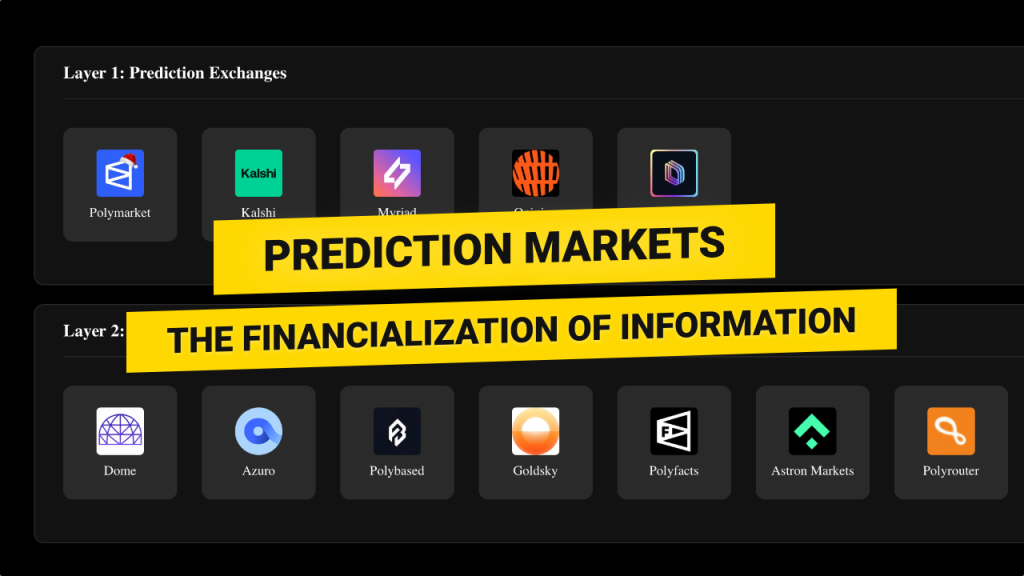
This market map represents the “financialization of information” (Think of Polymarket and Kalshi as the current main exchanges). In this ecosystem, world events are treated like stocks, and the tools below are what traders, developers, and everyday users use to navigate this new economy.
Management Tools for Prediction Markets
What is this category about?
This category represents the “Institutional Financial tools” of the ecosystem. It is here that prediction markets evolve from “betting platforms” into a sophisticated asset class where capital is managed, leveraged, and put to work over long durations.
Wealth Infrastructure & Credit Protocols
- The Big Picture: This category is about capital efficiency and delegation. It addresses the “capital lock” problem, where money is stuck in a trade for months waiting for an event to happen. These tools allow users to borrow against their winning positions, invest in professionally managed “truth funds,” or create yield-bearing assets based on factual outcomes.
- Role in the Layer System: Sitting at the apex of the framework, this category treats the prediction shares created in Layer 1 as Financial Collateral. It relies on the analytical signals from Layer 1 & 2 to assess risk and uses the execution tools of Layer 3 to manage the underlying assets.
Wha t are the core values provided?
- Credit & Leverage: Protocols like Gondor.fi allow you to use your “Yes” shares as collateral to borrow stablecoins (USDC). This lets you stay in your trade while still having cash to spend elsewhere.
- Managed Exposure (Funds): Tools like Polyfund.so enable “social investing,” where users can put their money into a vault managed by a top-tier forecaster rather than picking every trade themselves.
- Synthetics & Yield: Platforms like Facts.trade turn event outcomes into perpetual financial instruments, allowing users to earn yield or hedge long-term macro risks without the constraints of a binary “start and end” date.
- Risk Mitigation: These tools professionalize risk management by offering ways to hedge large bets or diversify across hundreds of different “Truth” assets automatically.
Who are the main user groups targeted?
- Passive Investors: Retail users who believe in the growth of the “Truth Economy” but prefer to delegate their capital to expert managers or automated funds.
- Power Traders: Sophisticated individuals using leverage to “loop” their positions (borrowing against a win to buy more) to maximize their returns on high-conviction signals.
- The “Assetization” of Truth: The most important shift in this category is the move from “betting” to “Holding. “By providing loans and fund structures, these companies turn a prediction into a productive financial asset that can be part of a long-term savings or investment strategy.
3 Capital Management Tools for Prediction Markets

💵 Seed
Gondor is a decentralized lending protocol designed specifically for prediction market participants. It effectively acts as the “Bank of the Truth Economy,” allowing users to treat their betting positions as financial collateral.
Here is a breakdown of what Gondor is and the mechanics of how it functions:
- The Problem It Solves: Traditionally, prediction markets suffer from “Capital Lock.” If you bet on an event that resolves in 6 months (like an election), your money is stuck for half a year.
- The Solution: Gondor allows you to “unlock” that capital. You can keep your bet active while simultaneously accessing cash to use for other trades or life expenses.
- The Technology: It is built as a non custodial layer (using Morpho Blue infrastructure), meaning Gondor never technically “holds” your money; the logic is handled by audited smart contracts.
How it Works: The Mechanics
- Collateralizing Shares: On platforms like Polymarket, your positions are represented by ERC-1155 tokens(Yes/No shares). Gondor allows you to deposit these tokens into their lending pools.
- The Loan-to-Value (LTV): You can typically borrow up to 50% of the current market value of your shares in USDC. For example, if you have $1,000 worth of “Yes” shares for an event, you can borrow $500.
- The “Looping” Strategy (Leverage): Because you receive USDC from the loan, you can immediately use that new cash to buy more shares of the same event. By repeating this, you can achieve up to 2x leverage on your original position.
- Interest & Repayment: You pay a small interest rate to the lenders who provide the USDC. You can repay the loan at any time to get your shares back, or the loan is automatically settled when the market resolves.
- Liquidation Protection: If the price of your “Yes” shares crashes (meaning the event becomes less likely to happen), the value of your collateral drops. If it drops below a certain threshold, the protocol will automatically sell your shares to repay the lenders, similar to how a margin call works in the stock market.
The Two Sides of the Market
- Borrowers (Traders): Use Gondor to get liquidity and amplify their gains through leverage.
- Lenders (Yield Earners): Users can deposit USDC into Gondor’s vaults to earn interest. This interest is paid by the traders and is often higher than standard DeFi rates because it is a specialized, high-demand market.

Indie Hacker
What is Fact Trade?
- A platform that lets users create and manage tokenized prediction market funds by packaging automated trading strategies and liquidity provisioning on Polymarket into on-chain funds that others can back and participate in.
- It is built by the team behind Polyfactual, tying it to an existing prediction market infrastructure project rather than a traditional VC-led startup.
- Targets: Anyone who want to launch a tokenized prediction market fund.
- Monetization: No info yet.
Major and distinctive features:
- Tokenized Fund Creation. Users can spin up an on-chain fund linked to a specific prediction market strategy, set risk parameters and target markets, and allow others to contribute capital.
- Automated Strategy Execution. The strategy trades markets like Polymarket automatically on behalf of the fund, meaning the logic driving predictions and trades can be modular and reused.
- Capital Aggregation and Sharing. Backers can buy into the tokenized fund and earn a share of profits proportional to their stake, turning prediction market signals and strategies into reusable financial primitives rather than one-off trades.

Indie Hacker
What is PolyFund:
- PolyFund is a capital management and fund infrastructure platform for prediction markets that allows forecasters to create managed funds on top of Polymarket, and lets investors allocate capital to those funds instead of trading individual events.
- The platform is designed to professionalize forecasting skill, turning top predictors into fund managers and prediction markets into a delegable asset class.
- Project type: Independent / indie hacker type.
- Targets: Pro-traders / power users.
Major and distinctive features:
- Prediction market funds (vaults). Traders can create dedicated funds that allocate capital across multiple Polymarket events, allowing investors to gain diversified exposure through a single deposit.
- Delegated capital management. Investors delegate decision-making to fund managers, removing the need to monitor markets, manage timing, or rebalance positions manually.
- Portfolio diversification across events. Funds can spread capital across different themes, time horizons, and event types, reducing the binary risk profile of single-market bets.
- Performance based incentive alignment. Fund managers are incentivized through performance or management fees, aligning forecasting accuracy with capital growth rather than volume of trades.
- Continuous capital deployment. As events resolve, capital can be recycled into new positions, reducing idle capital and mitigating the long lock-up periods typical of prediction markets.