
This post is part of a series covering the unbundling and automation of the restaurant business. You can view the full interactive map with more than 50 startups here.
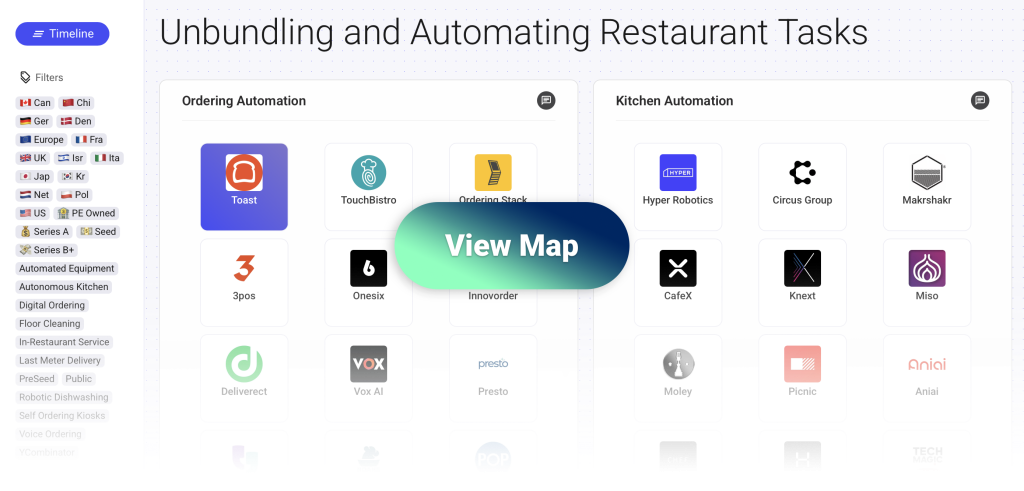
Automation, robotics and AI are reshaping every step of restaurant work, from the moment a customer orders to the way kitchens prepare food, deliver dishes, clean tables and manage ingredients. This deep dive shows a concrete view of the emerging technologies that take over repetitive tasks will help restaurants at a time when fewer people want to do these roles.
Restaurant Supply and Inventory Management
This category covers the tools and systems that help restaurants manage ingredients, supplies and stock levels. It spans procurement, storage and inventory tracking.
How automation, robotics and AI are changing it:
IoT sensors monitor quantity and freshness inside fridges or storage bins. Software predicts demand, suggests orders and reorders ingredients automatically. Procurement platforms centralize all supplier interactions. These capabilities reduce waste, prevent stock shortages and save large amounts of administrative time.
Subcategories
Smart Inventory Systems:
- Sensors, smart bins or vision tools that track stock levels in real time.
- Automatically flag low quantities and sync with ordering tools.
- Improve accuracy and reduce manual stock counting.
Automated Procurement Platforms:
- Digital systems for ordering ingredients from suppliers.
- Auto generate purchase orders based on par levels or forecasts.
- Consolidate vendors in one place and streamline invoicing.
- Automated Storage and Ingredient Handling
- Robotic or semi robotic systems that manage ingredient storage.
- Track usage and help move items efficiently between storage and prep areas.
- Maintain optimal conditions for food safety and reduce spoilage.
4 Startups Automating Restaurant Supply and Inventory Management
🇦🇺 Aus – PreSeed
What they do:
- FOBOH provides AI driven software for food and beverage wholesalers and distributors to automate order capture, customer support, administrative tasks and inventory workflows.
- The platform reads and processes orders from emails, messages or attachments and turns them into structured data that flows directly into the company’s internal systems.
- It assists with forecasting, sales suggestions and anomaly detection so suppliers can spot reorder patterns, stock issues or customer changes early.
- Billing and collections are automated through generated invoices, payment tracking and reminders that improve cash flow.
- The system acts as a digital assistant workforce for distributors who deal with many SKUs and high operational complexity.
Company specificities:
- FOBOH structures its AI capabilities around clear functional agents such as order entry assistance, sales support, insights and collections, which helps companies pick exactly what they need.
- The platform handles messy real world data from wholesale operations and unifies it across formats and channels so automation becomes reliable.
- Operational costs drop as routine tasks get automated and error rates decline, allowing teams to handle higher volumes without scaling staff.
- The solution supports large SKU catalogs and growing customer bases so distributors can scale operations without creating bottlenecks.

🇪🇺 Europe – 🇮🇪 Ire – 💸 Series B+
What they do:
- Nory is an AI driven platform that helps restaurants manage inventory, workforce, payroll, sales forecasting and daily operations.
- The system predicts customer demand so restaurants can order the right amount of stock, plan prep more efficiently and reduce waste.
- Workforce tools support scheduling, onboarding and payroll while tracking labour costs in real time.
- Inventory management connects recipes to ingredient usage which improves cost control and visibility across the kitchen.
- Dashboards give operators a clear view of performance with insights on sales, labour, food cost and operational efficiency.
Company specificities:
- The product is built specifically for hospitality and understands restaurant workflows and peak service rhythms which makes the insights practical and accurate.
- AI powered forecasting helps restaurants lower labour costs and reduce food waste which directly improves margins.
- Nory connects with existing POS, accounting and payroll systems which keeps adoption simple for restaurants that already have a tech stack.
- The platform scales from single outlets to large multi site groups and aims to deliver consistent operations across all locations.

🇨🇦 Can
What they do:
- OrderGrid provides a unified platform for managing inventory, demand forecasting, replenishment, order orchestration and fulfilment for grocers, food retailers, restaurants and distributors.
- The system predicts upcoming demand through AI models so operators can prepare accurate stock levels and avoid waste or stockouts.
- It automates procurement workflows by generating purchase orders, managing supplier rules and triggering replenishment when inventory reaches defined thresholds.
- Real time inventory tracking covers lot codes and expiry dates, giving full visibility across warehouses, stores and dark store fulfilment setups.
- OrderGrid supports order fulfilment by coordinating picking, packing, cold chain handling and logistics for online delivery, click and collect and in store orders.
Company specificities:
- The platform combines planning, orchestration and execution in one place, which reduces reliance on multiple disconnected tools and simplifies operations.
- Its forecasting and replenishment logic is tailored to perishables and grocery workflows where shelf life, volatility and supplier lead times must be balanced precisely.
- The architecture is cloud native and integrates with existing retail systems and sales channels, making deployment manageable for both small operators and multi region chains.
- Clients typically see gains in accuracy, reduced waste, fewer stockouts and smoother fulfilment operations, which translate into higher margins and stronger customer satisfaction.

What they do:
- MarketMan provides a cloud based platform that helps restaurants and hospitality operators manage inventory, purchasing and supplier relationships with greater accuracy and less manual work.
- The system automates the entire purchasing flow by generating purchase orders, sending them to vendors, receiving deliveries and updating stock levels automatically.
- Ingredient level tracking allows restaurants to monitor real time stock, detect waste or shrinkage and prevent shortages before they happen.
- Recipe and menu costing tools break down each dish into its ingredient costs so operators can understand margins, adjust pricing and improve profitability.
- The platform also supports invoice scanning, accounts payable automation, waste logging and detailed reporting to streamline back of house operations.
Company specificities:
- MarketMan integrates smoothly with POS systems, accounting software and food distributors which makes adoption easy without replacing existing tools.
- A cloud native design allows staff to manage purchasing and inventory from tablets or phones directly on the kitchen floor or during supplier deliveries.
- The platform unifies purchasing, inventory, recipe costing and waste tracking in one place which removes data silos and reduces administrative overhead.
- Many operators see tangible operational gains such as lower food costs, fewer stockouts, reduced administrative time and clearer visibility into overall performance.