
This post is part of a series covering the unbundling and automation of the restaurant business. You can view the full interactive map with more than 50 startups here.
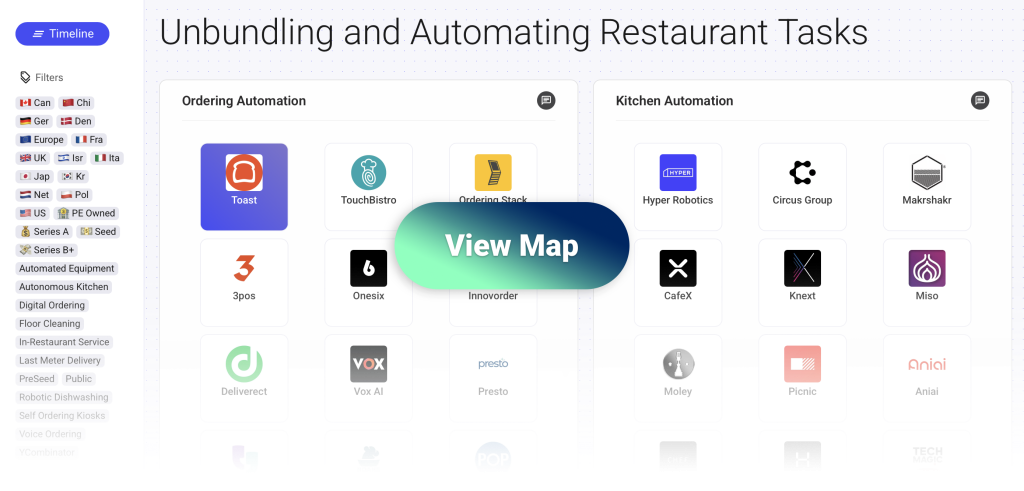
Automation, robotics and AI are reshaping every step of restaurant work, from the moment a customer orders to the way kitchens prepare food, deliver dishes, clean tables and manage ingredients. This deep dive shows a concrete view of the emerging technologies that take over repetitive tasks will help restaurants at a time when fewer people want to do these roles.
Restaurant Cleaning and Dishwashing
This category covers machines and robots that handle the cleaning tasks in restaurants, from clearing tables to washing dishes and sanitizing the kitchen.
How automation, robotics and AI are changing it:
Robots can identify dirty surfaces, collect trays, clean floors and run dish cycles with minimal supervision. Vision systems detect dirt and optimize cleaning paths. This reduces one of the most labor intensive parts of restaurant work and helps maintain consistent hygiene levels.
Robotic Table Cleaning:
- Robots that clear dishes and wipe tables after customers leave.
- Recognize spills or leftover items using sensors or vision.
- Keep dining rooms clean with minimal staff input.
Robotic Dishwashing Systems:
- Automated units that sort, load and wash dishes without manual scrubbing.
- Handle repetitive sink work and improve sanitation.
- Reduce staff fatigue and free up labor for customer facing roles.
4 Startups Automating Restaurant Cleaning and Dishwashing
Nala Robotics
🇮🇳 Ind
Robotic Dishwashing
What they do:
- Spotless is a fully automated robotic dishwasher for commercial kitchens that handles detection, pre cleaning, washing, drying and stacking of kitchenware.
- The system operates continuously and maintains dishwashing capacity even during peak periods or staff shortages.
- It supports many types of kitchen items such as plates, bowls, utensils, cookware and glassware and adapts its cleaning routine to each item.
- Installation can fit into existing kitchen layouts which lowers the need for major renovation or infrastructure changes.
- Operators get visibility into throughput, hygiene status and performance through logged workflows and system analytics.
Company specificities:
- The robot uses AI and computer vision to recognise dishes and select the correct cleaning routine which offers more adaptive automation than fixed wash cycles.
- A robotics as a service model reduces upfront cost and allows restaurants to adopt the system through subscription rather than large equipment purchases.
- Automating dishwashing helps address one of the hardest roles to staff in food service and reduces turnover associated with repetitive back of house tasks.
- Spotless is designed to scale within larger automated kitchen setups and supports high volume environments like cloud kitchens or busy commercial kitchens.

🇺🇸 US – 💵 Seed – Robotic Dishwashing
What they do:
- Armstrong develops AI powered robots for restaurant kitchens, beginning with automating dishwashing tasks.
- The robot works with standard commercial dish machines and handles scraping, rinsing, stacking and racking around the clock.
- Restaurants use it to reduce reliance on one of the most difficult and highest turnover jobs in the kitchen, freeing staff for service oriented tasks.
- Operators pay through a subscription model that includes installation, maintenance and ongoing support which avoids heavy upfront costs.
- The long term goal is to evolve the system into a general purpose kitchen robot that can take on additional prep or cleaning duties.
Company specificities:
- Advanced 3D perception and neural network models give the robot the ability to recognise dishes in messy real world piles and manipulate them reliably.
- The system integrates into existing kitchen layouts without the need for costly remodeling which makes adoption easier for restaurants of all sizes.
- A subscription based approach makes scaling predictable for multi location groups.
- The company focuses on building a platform rather than a single feature robot which supports expansion into broader kitchen automation tasks.

🇺🇸 US – 💵 Seed – Floor Cleaning – YCombinator
What they do:
- Somatic designs autonomous robots that clean commercial restrooms without human intervention.
- The robot handles spraying, scrubbing, rinsing, drying and other routine cleaning actions to keep facilities consistently hygienic.
- Property managers, office buildings, airports and similar venues use the system to maintain restrooms that see high traffic and require constant upkeep.
- The service runs through a subscription model so clients receive a fully maintained robot without needing upfront capital investment.
- The goal is to deliver reliable, repeatable cleaning quality while reducing the workload and turnover issues tied to manual restroom cleaning.
Company specificities:
- The robot is purpose built for restrooms which are complex and variable environments that general floor-cleaning robots struggle with.
- Automation covers the full workflow, including navigating tight spaces, accessing stalls and managing cleaning cycles with minimal human oversight.
- Somatic positions the offering as a managed service where installation, maintenance and monitoring are bundled into one predictable monthly fee.
- By focusing on one of the hardest janitorial tasks, the system offers strong value for buildings that need dependable hygiene standards across many restrooms.

🇯🇵 Jap – Robotic Dishwashing
What they do:
- Yaskawa develops hygienic robotic arms that sort, pick and load dirty dishes in commercial kitchens
- The system uses vision AI to recognise plates, bowls, cutlery and trays even when piled or messy
- Robots remove food residues, move items into washing stations and help automate the full dishwashing workflow
- The solution targets large kitchens such as hotels, hospitals, catering sites and institutional foodservice
- The robotic cell is modular and mobile so it fits into existing dishwashing rooms with minimal redesign
Company specificities:
- Hardware is engineered for hygiene with smooth surfaces, sealed joints and materials that tolerate intensive cleaning
- Vision AI enables handling of diverse and unpredictable stacks of dishes which is difficult for classic industrial robots
- The solution covers the complete workflow from detection to pre-cleaning and loading rather than delivering isolated components
- Modular design lowers adoption barriers by allowing quick installation without rebuilding the entire kitchen setup