
This post is part of a series covering the unbundling and automation of the restaurant business. You can view the full interactive map with more than 50 startups here.
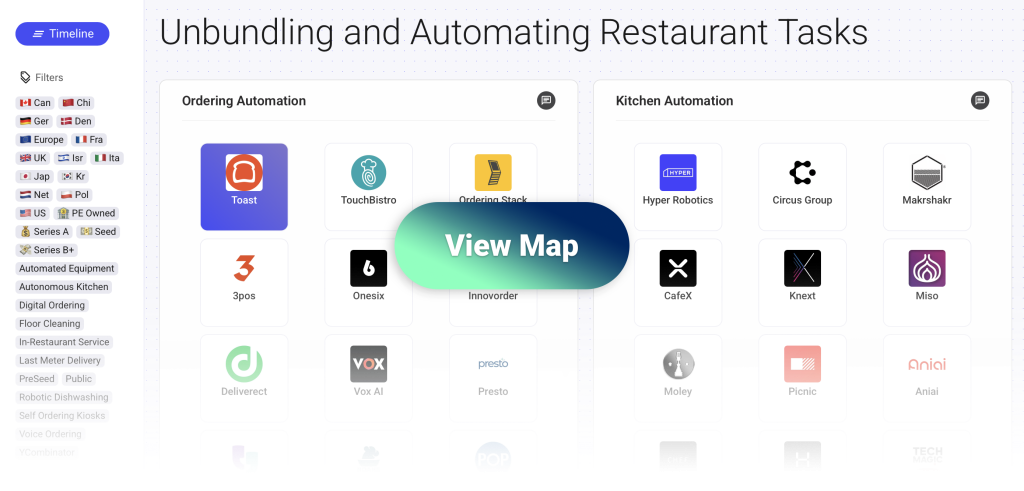
Automation, robotics and AI are reshaping every step of restaurant work, from the moment a customer orders to the way kitchens prepare food, deliver dishes, clean tables and manage ingredients. This deep dive shows a concrete view of the emerging technologies that take over repetitive tasks will help restaurants at a time when fewer people want to do these roles.
Food Service and Delivery
This category includes robots that move food inside the restaurant or help deliver it to customers. They focus on transport rather than cooking or ordering.
How automation, robotics and AI are changing it:
Service robots carry plates, run orders between the kitchen and tables, and reduce the walking workload of staff. Navigation systems let robots move safely through crowded dining rooms. Over time, these robots help restaurants run smoother operations with fewer bottlenecks.
In Restaurant Service Robots:
- Robots that carry dishes to tables or return items to the kitchen.
- Reduce staff walking time and help during busy hours.
- Navigate autonomously using sensors and indoor mapping.
Last Meter Delivery Robots:
- Robots that move food from the kitchen to pick-up points or delivery staff.
- Keep order flow steady and reduce delays during peak service.
- Improve hygiene by minimizing unnecessary human handling.
12 Startups Automating Food Service and Delivery

🇨🇳 Chi – 💸 Series B+ – In-Restaurant Service
What they do:
- The T11 is an autonomous service robot that transports dishes, drinks and trays from the kitchen to tables or pickup points inside a restaurant.
- Its compact design allows it to move through very narrow aisles which makes it suitable for crowded dining rooms or small venues.
- A multi level tray system lets the robot carry several orders in one run which helps staff serve more tables with fewer trips.
- Navigation relies on sensors and real time obstacle detection so it can move safely around guests and furniture.
- The robot can also assist with clearing tables by returning empty trays or dishes to the kitchen.
Company specificities:
- Maneuverability is a core strength as the robot maintains high stability and precise movement even in tight layouts.
- Load balancing across multiple trays supports efficient multi order delivery without slowing down the robot.
- The robot is built with strong safety features including shock absorption and responsive obstacle avoidance to minimise spills or collisions.
- Optional custom branding, lights and voice interactions allow the T11 to act as both a service tool and an engaging guest facing element.
🇨🇳 Chi – In-Restaurant Service
What they do:
- Reeman designs autonomous service robots that carry meals, dishes or goods through indoor spaces such as restaurants, cafés, hotels or hospitals.
- Robots navigate on their own using sensors and mapping to reach tables or rooms without human escort.
- Staff assign a destination and the robot plans the route, delivers the items and returns for the next task.
- Several models carry multiple trays or bins which helps move many orders in a single trip.
- Battery management is automated as robots return to the charging dock on their own when power runs low.
Company specificities:
- Navigation relies on a mix of sensors which improves accuracy and obstacle detection in busy or unpredictable environments.
- The robots fit narrow aisles and compact layouts which makes them suitable for venues with limited space.
- A broad product line covers simple delivery tasks all the way to complex multi bin transport which lets operators choose the right level of automation.
- Installation does not require heavy changes to the venue since the robots work with existing floor plans and service routines.

🇩🇪 Ger – 🇪🇺 Europe – In-Restaurant Service
What they do:
- RoboPlanet supplies service robots for restaurants, hotels, retail spaces, hospitals and event venues where routine service or delivery tasks occur frequently.
- Robots deliver food and items to tables, collect trays, guide guests, greet visitors or serve as mobile display units for promotions.
- Navigation systems let the robots move autonomously indoors, avoiding obstacles and operating reliably even in busy or changing environments.
- The company also offers cleaning and transport robots for hygiene, logistics and facility support tasks.
- Their solutions serve a wide range of operators who want to automate repetitive work and ease the load on staff.
Company specificities:
- A modular product line gives customers options across service, transport and cleaning robots so they can adopt only what fits their workflow.
- Flexible leasing, rental or purchase models reduce the financial barrier to implementing robotics.
- Robots are designed to navigate narrow corridors and typical indoor layouts which suits restaurants, retail aisles and healthcare environments.
- Deployment includes consulting, setup and maintenance support so operators receive help throughout onboarding and ongoing use.

🇨🇳 Chi – 💸 Series B+ – In-Restaurant Service
What they do:
- Pudu Robotics produces autonomous service robots that deliver food, drinks and items inside restaurants, hotels, hospitals and similar venues.
- Robots navigate indoor spaces using sensors and mapping so they can move safely through dining rooms, avoid obstacles and reach tables or rooms reliably.
- Many models include multiple trays and sizable load capacity which allows them to deliver several orders in a single run during busy moments.
- Some units also support table clearing or returning dishes, reducing repetitive manual tasks for staff and smoothing the service flow.
- Their systems work in small cafés, large restaurants, hotels, clinics and other settings where frequent delivery or transport tasks occur.
Company specificities:
- The company offers a wide product portfolio that spans delivery robots, cleaning robots and semi humanoid assistant robots which covers many automation needs.
- Robots rely on advanced sensor fusion and autonomous navigation so they operate safely in crowded environments without needing special markers or infrastructure.
- Tray based designs with high carrying capacity are built for real restaurant workloads and help teams handle high order volume.
- Global deployments across many industries show strong maturity and adaptability for different service environments.

🇨🇳 Chi – In-Restaurant Service
What they do:
- OrionStar builds autonomous service robots for restaurants that deliver meals, drinks and dishes from the kitchen to tables or pickup points.
- Robots can also greet customers, guide them to their tables and help with clearing duties such as returning used dishes.
- Navigation relies on sensors, depth mapping and AI driven SLAM so the robots can move safely through busy and dynamic dining rooms.
- Integration with order management or POS systems allows robots to collect orders automatically once they are ready and deliver them without staff involvement.
- Multi tray capacity lets a robot serve several tables in one trip which boosts throughput during peak hours.
Company specificities:
- The robots operate within a broader smart restaurant solution that includes smart positioning, smart summon and coordinated multi robot workflows.
- Multiple operating modes such as greeting, guiding, serving and clearing allow the robots to support many different service tasks beyond simple delivery.
- Robust navigation and real time environment scanning make the robots suitable for crowded or narrow restaurants where safety and precision matter.
- High daily delivery capacity shows that one robot can replace a significant amount of repetitive server work which helps restaurants address labor shortages and improve efficiency.
🇺🇸 US – In-Restaurant Service – Public
What they do:
- Scorpion is a robotic bartender that prepares and serves drinks such as cocktails, coffee, teas and other mixed beverages.
- Customers receive consistent drinks thanks to precise ingredient measurement and automated mixing handled entirely by the robot.
- The system runs continuously and can produce drinks at a steady pace which suits high traffic bars or beverage counters.
- Up to twenty ingredients can be stored in the machine which enables a broad menu of recipes and custom combinations.
- Its compact footprint makes the unit suitable for bars, cafés, hotels and venues where space is limited.
Company specificities:
- The robot uses AI for drink suggestions, gesture recognition and safe interaction which creates a more engaging experience for customers.
- A single arm design keeps the hardware compact and cost efficient while still performing full bartending actions.
- Throughput is high with the capability to prepare roughly one drink per minute which supports heavy demand periods.
- The company offers full deployment support including planning, installation and maintenance so venues receive an end to end service package.

🇺🇸 US – 💸 Series B+ – In-Restaurant Service
What they do:
- Bear Robotics builds autonomous service robots that deliver food, drinks and dishes inside restaurants and hospitality venues.
- The robots handle repetitive tasks such as taking orders from the kitchen to tables or returning used dishes which frees staff to focus on guest interaction.
- Multi robot coordination allows several units to work together during peak hours and support high volumes of service runs.
- Navigation is fully autonomous and relies on sensors and AI so the robots move safely through crowds, narrow aisles and dynamic indoor environments.
- Typical customers include restaurants, hotels, senior care facilities and ghost kitchens that need more efficient service or face staffing shortages.
Company specificities:
- The Servi product line is designed specifically for hospitality which results in smooth navigation, hygienic materials and functions suited for restaurant workflows.
- A central fleet management system coordinates multiple robots and makes it easy to scale operations as demand increases.
- The approach focuses on reducing repetitive workloads rather than replacing human staff which helps improve team efficiency and retention.
- Use cases span many settings beyond restaurants which shows strong versatility and broad applicability across hospitality and care environments.
🇺🇸 US – 💸 Series B+ – Last Meter Delivery
What they do:
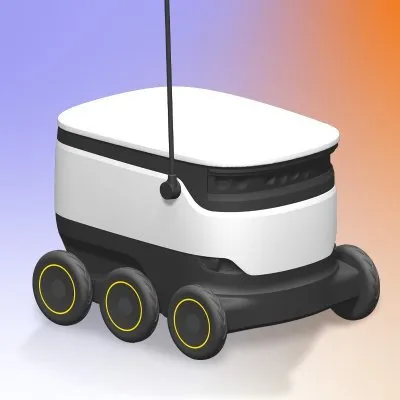
- Starship operates small autonomous sidewalk robots that deliver food, groceries and packages directly to customers.
- Customers order through an app and a robot travels from the store or restaurant to the delivery point using pavements instead of roads.
- The service focuses on short-distance last-mile delivery, making fulfilment fast, predictable and available at any time of day.
- Robots are used on university campuses, in residential neighbourhoods and in partnership with retailers, supporting a wide range of delivery scenarios.
- The goal is to replace or complement traditional courier services with a reliable, low-cost and fully automated alternative.
Company specificities:
- Robots operate with high autonomy and rely on sensors and computer vision to navigate pavements, avoid obstacles and cross streets safely.
- Each robot has a secure locked compartment that only the customer can open through the app, protecting the delivered items.
- Electric power and efficient batteries make the system energy-savvy compared with car based delivery options.
- Automating last-mile delivery helps retailers and restaurants reduce costs and scale delivery even in areas where human courier economics do not work well.

🇺🇸 US – Last Meter Delivery
What they do:
- Robot.com builds autonomous robots that take on real world tasks such as food delivery, package delivery, logistics support, inspection and mobile advertising.
- The robots operate both indoors and outdoors and can travel across sidewalks, campuses or large facilities to move items between pickup points and customers.
- Their systems run with high autonomy and handle navigation, obstacle avoidance and routing without human intervention.
- The company serves businesses that need scalable automation such as campuses, restaurants, logistics operators, retailers and service environments.
- Robots can also act as helpers inside commercial spaces, supporting kitchen tasks, transport duties or other repetitive workflows.
Company specificities:
- Their fleet is already deployed at scale, which shows real world reliability rather than experimental testing.
- The product line covers many use cases, from delivery robots to cargo carriers, inspection units and service assistants, giving clients flexibility depending on needs.
- Safety and dependable navigation are core design goals, enabling operation in busy, human populated environments with minimal supervision.
- The company evolved from early delivery robot experience into a broader automation platform, reflecting a long term approach to building robotic infrastructure.
🇺🇸 US – 💰 Series A – Last Meter Delivery
What they do:
- Serve Robotics builds autonomous sidewalk robots that deliver food, groceries and small packages directly to customers.
- The robots navigate city sidewalks on their own using sensors and AI to avoid obstacles and move safely around pedestrians.
- Once a customer places an order through a partner app, a robot is dispatched and carries the items in a secure compartment that only the customer can unlock.
- The system focuses on short distance last mile deliveries which helps restaurants and stores handle frequent small orders efficiently.
- Serve operates fleets in several urban areas and has completed many real world deliveries which shows that the platform works at scale.
Company specificities:
- Robots operate with high level autonomy which allows them to move in unpredictable outdoor environments rather than relying on controlled routes.
- The delivery compartment is secure so customers retrieve their items safely while theft or tampering risks stay low.
- Serve partners with large food delivery and retail platforms which gives access to many merchants and supports rapid scaling.
- The electric robot model helps reduce traffic and emissions while lowering the cost of short range deliveries compared with car based couriers.

What they do:
- Coco operates small autonomous sidewalk robots that deliver food, groceries and everyday items from local merchants to customers in dense urban areas.
- Orders placed through partner platforms are fulfilled by loading items into a robot that then travels on sidewalks to the customer’s address.
- The delivery compartment stays locked during the trip and can be opened by the customer upon arrival.
- The system provides a sustainable and low cost alternative to car based couriers since the robots run on electricity and focus on short distance trips.
- The service integrates with existing restaurant and retail workflows so staff need only load, lock and dispatch the robot.
Company specificities:
- The robots use a combination of cameras, lidar and GPS supported by AI navigation to move safely through complex city sidewalks.
- Adoption is simple because merchants do not need new infrastructure or special training which lowers friction for small restaurants and shops.
- By reducing car based short trips, the service lowers emissions and helps reduce traffic in neighbourhoods where delivery volumes are high.
- The company has completed a large number of real world deliveries which shows reliability across varied environments and weather conditions.

🇪🇺 Europe – 🇮🇪 Ire – Last Meter Delivery
What they do:
- Manna operates autonomous drones that deliver food, groceries and small goods directly to customers in a matter of minutes.
- Orders made through partner apps are picked up at a local hub where drones are loaded and sent to the customer’s location.
- Delivery happens by air which avoids road traffic and reduces delays, making the service faster than traditional courier or car based delivery.
- The drone lowers the package safely to the customer’s yard or designated drop off spot without requiring anyone to meet it at the door.
- The service targets restaurants, grocery stores and retailers that want ultra fast last mile delivery without relying on drivers.
Company specificities:
- Their drones are fully electric and produce no emissions which makes the model more sustainable than car based deliveries.
- The company has already completed a large number of real world flights with regulatory approval which shows that the system is mature and reliable.
- Safety features such as redundant motors and onboard failsafes increase reliability and lower operational risk.
- Air based delivery helps reduce congestion and enables consistently fast delivery times even in high traffic urban areas.