
This post is part of a series covering the unbundling and automation of the restaurant business. You can view the full interactive map with more than 50 startups here.
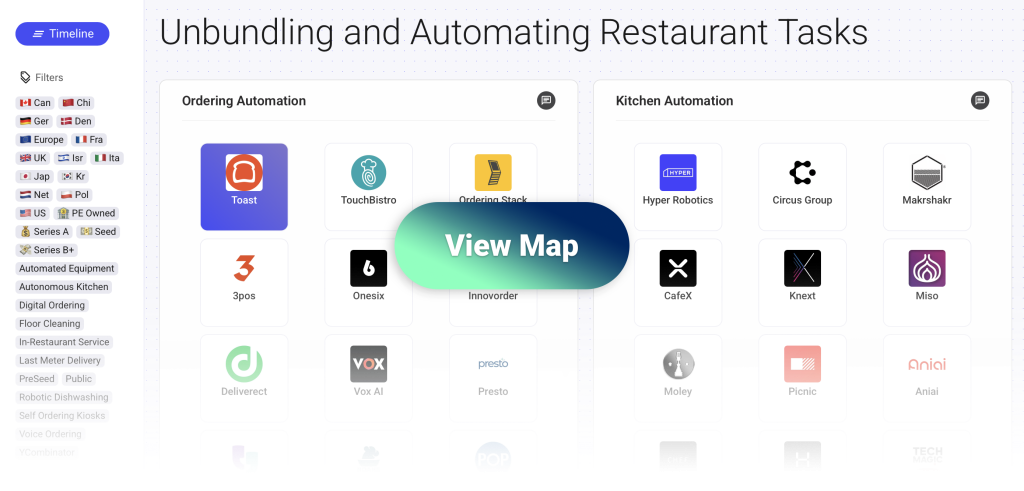
Automation, robotics and AI are reshaping every step of restaurant work, from the moment a customer orders to the way kitchens prepare food, deliver dishes, clean tables and manage ingredients. This deep dive shows a concrete view of the emerging technologies that take over repetitive tasks will help restaurants at a time when fewer people want to do these roles.
Restaurant Ordering
Ordering automation enables customers to place their food orders without help from a waiter or cashier. These systems remove friction for both sides: customers order faster and restaurants reduce labor pressure at peak hours.
How automation, robotics and AI are changing it:
AI voice agents handle phone or drive through orders with natural conversation. Smart kiosks adapt menus based on time of day or inventory. Digital ordering layers connect with kitchen software so orders flow instantly to the right station. These tools reduce mistakes and shorten wait times while freeing staff for higher value tasks. Another aspect is multilingual capacity as, unlike a human waiter, these solutions can take orders in any languages.
Subcategories
Digital Ordering Platforms:
- Online or mobile interfaces that let customers browse menus and order directly.
- Often integrate with payment systems, loyalty programs and delivery channels.
- Automatically relay orders to the kitchen and update availability in real time.
Self Ordering Kiosks:
- Touchscreens placed inside the restaurant so customers order without staff.
- Present personalized menus, upsell suggestions or allergen filters.
- Reduce queues and smooth the order flow during peak service.
Voice Ordering Systems:
- AI voice agents that take orders by phone or at drive through lanes.
- Understand natural speech and handle complex requests or modifications.
- Cut wait times, reduce order errors and let restaurants operate with fewer staff during rush periods.
16 Startups Automating Restaurant Ordering

🇺🇸 US – 💸 Series B+ – Voice Ordering
What they do:
- Kea AI provides a conversational voice ordering system that answers restaurant phone calls and captures orders through natural speech.
- Orders flow directly into the restaurant’s POS so the kitchen receives them without manual entry or risk of missed calls during peak hours.
- The assistant understands customizations, modifiers and complex phrasing which helps customers place accurate orders without needing staff.
- The service keeps call lines active at all times which reduces lost revenue from unanswered phones when teams are busy.
- Deployment is designed to be simple which allows restaurants to get the system running quickly with minimal technical setup.
Company specificities:
- Restaurants can personalise the assistant’s voice and tone so the ordering experience matches their brand identity.
- Deep menu logic lets the AI interpret many ways of describing the same item which improves accuracy across diverse customer phrasing.
- A human in the loop can intervene when the AI detects uncertainty which ensures orders remain correct even in edge cases.
- Kea AI is priced and packaged to be accessible for smaller operators which brings advanced voice automation beyond large chains.

🇺🇸 US – Public – Self Ordering Kiosks
What they do:
- Toast is a full restaurant operating system, but its self service kiosk is a dedicated product that allows guests to place their own orders without staff involvement.
- The kiosk lets customers browse the menu, customize meals and complete payment through an intuitive on screen flow.
- Orders placed on the kiosk go directly to the kitchen display system, removing manual re entry and speeding up preparation.
- It supports dine in and takeout formats and fits environments with high order volume such as quick service and fast casual restaurants.
- The kiosk is designed to shorten queues, increase throughput and reduce pressure on front of house teams during peak hours.
Company specificities:
- Because the kiosk is part of Toast’s full stack platform, it connects seamlessly with POS, kitchen systems, menu management, loyalty and payment processing.
- The ordering flow is built to be simple and guest friendly which helps customers navigate choices and complete checkout with little friction.
- Upsell and modifier prompts are integrated into the flow which often increases average ticket size compared to manual ordering.
- The hardware is built for restaurant conditions with durability suited for high traffic and frequent use.
🇨🇦 Can – 🏦 PE Owned – 💸 Series B+ – Self Ordering Kiosks
What they do:
- TouchBistro provides a restaurant management platform built around a modern POS that helps venues run ordering, payments, tables, menus and staff operations from one system.
- Tableside ordering on tablets allows servers to take orders faster, customize dishes easily, split bills and send everything straight to the kitchen.
- Back of house teams get real time inventory tracking, recipe cost tools, kitchen display connectivity and staff scheduling features that improve operational control.
- Guest engagement tools include online ordering, loyalty programs, gift cards, marketing campaigns and reservations that connect directly with in-venue operations.
- Multi location groups can manage menus, reporting, staff data and financials centrally which brings consistency and better oversight across sites.
Company specificities:
- The platform is structured as an all in one system that unifies front of house, back of house and customer facing capabilities, reducing the need for multiple disconnected vendors.
- A strong focus on ease of use makes the interface simple for new staff to learn which suits busy restaurants and venues with frequent team rotation.
- Real time links between sales, inventory and menu management help restaurants monitor ingredient usage, forecast demand and avoid waste.
- Flexibility across dining formats means the system works for quick service, fast casual, fine dining and multi unit operations.

🇪🇺 Europe – 🇵🇱 Pol – Self Ordering Kiosks
What they do:
- The platform provides digital ordering for restaurants through self service kiosks, web ordering, mobile apps and table or QR based ordering.
- All channels feed into a unified order management layer that synchronises with the restaurant’s POS and kitchen display system.
- Different order types such as dine in, takeaway, pickup and delivery are supported, including payments handled through the customer’s device or the POS.
- Loyalty and marketing features help restaurants create repeat business through points, rewards, coupons and customer segmentation.
- The solution is aimed at restaurant chains and multi location operators, particularly in fast service environments where automation improves throughput.
Company specificities:
- A strong integration first approach lets restaurants keep their existing POS or ERP system while adding modern digital ordering on top.
- Kiosk software works with many types of hardware which gives operators freedom to choose devices that fit their layout and budget.
- Omnichannel orchestration merges kiosk, web, mobile and third party delivery orders into one workflow which reduces staff effort and errors.
- A track record with large restaurant brands shows the platform can handle high volume operations reliably.

🇩🇪 Ger – 🇪🇺 Europe – Self Ordering Kiosks
What they do:
- The company provides a web based POS and restaurant management system that supports cafés, bars, food trucks and fast service venues.
- Its self ordering feature lets guests place and pay for their orders directly through a touchscreen kiosk or through their own phone by scanning a QR code.
- Orders are transmitted instantly to the kitchen display so staff can prepare dishes without manual re entry or paper slips.
- The system supports dine in, takeaway and delivery flows and connects payment processing, order management and pickup status screens.
- Back office tools include menu management, price updates, inventory tracking and multi location administration.
Company specificities:
- A modular approach lets venues choose between software only setups or full packages including POS terminals, printers and kiosks.
- Self ordering is available both through physical kiosks and through a virtual waiter experience on mobile devices which gives flexibility across restaurant formats.
- Strong links between POS, ordering, kitchen display, inventory and payments create a unified workflow rather than separate systems.
- Device agnostic design allows the system to run on tablets, phones, PCs or kiosks which lowers hardware costs for smaller operators or mobile food concepts.

🇪🇺 Europe – 🇳🇱 Net – Self Ordering Kiosks
What they do:
- Onesix provides self ordering kiosks that let guests place and pay for their meals through a touchscreen terminal or by scanning a QR code on their phone.
- Orders flow directly into the restaurant’s system where staff can view them on a tablet or POS interface without manual re entry.
- The platform supports dine in, takeaway and delivery workflows, making it suitable for restaurants, cafés, fast food venues and mobile food concepts.
- A central dashboard gives real time visibility into orders, sales and customer behavior which helps operators adjust menus and track performance.
- Optional modules such as a full POS system, kitchen displays and customer order status screens extend the core kiosk into a complete ordering environment.
Company specificities:
- Onesix builds its own hardware and software which creates a tightly integrated ecosystem and avoids reliance on third party components.
- The ordering flow includes guided upsells and customization options that gently increase average order value.
- A flexible subscription model with trial periods and monthly cancellation lowers the risk for small operators testing the system.
- Modular design lets venues adopt only the components they need which suits both small cafés and larger multi unit operators.

🇪🇺 Europe – 🇫🇷 Fra – 💸 Series B+ – Self Ordering Kiosks
What they do:
- Innovorder offers a full stack restaurant management and ordering platform that covers order taking, checkout, kitchen coordination, delivery flows and back office operations.
- Restaurants can deploy self ordering kiosks, QR based ordering or online ordering and every order flows directly into the kitchen or POS system.
- The platform supports dine in, takeaway, delivery and food court workflows which makes it suitable for single venues, franchises, dark kitchens and high traffic environments.
- Back office tools include menu management, inventory tracking, sales reporting, customer insights, loyalty programs and real time analytics across all channels.
- Multi site operators can manage menus, promotions and configurations centrally while keeping each location manageable from a unified dashboard.
Company specificities:
- The solution is fully built in house which creates a tightly integrated ecosystem across kiosk software, POS, back office tools and kitchen operations.
- A modular structure lets venues start with only the parts they need and expand as their operations grow which suits both small cafés and large chains.
- Continuous SaaS updates help the system evolve without extra upgrades or maintenance costs for customers.
- Broad integrations with delivery partners, payment services and analytics tools allow Innovorder to unify all ordering channels into one coordinated workflow.

🇺🇸 US – 💸 Series B+ – Self Ordering Kiosks
What they do:
- Deliverect provides a self service kiosk that lets guests place and pay for orders directly through a touchscreen interface.
- Orders flow straight into the kitchen or POS system which removes manual re entry and reduces mistakes during busy periods.
- The kiosk supports dine in, takeaway and counter service setups which suits quick service, casual dining and other high volume formats.
- Menu management is centralised so restaurants can update items, pricing, availability and promotions across all kiosks in real time.
- Built in upsell prompts and add on suggestions help increase average order value and encourage customers to personalise their meals.
Company specificities:
- The kiosk is part of a wider ecosystem that connects POS, online ordering and delivery platforms which unifies all sales channels under one system.
- Hardware is flexible as the kiosk can be installed as a floor stand, wall mount or countertop unit depending on the venue layout.
- Cloud based updates ensure stock changes, menu edits and promotions appear instantly across locations which keeps operations aligned.
- Early adopters highlight shorter queues and higher throughput during peak times which helps restaurants handle labour pressure more effectively.

🇪🇺 Europe – 🇳🇱 Net – 💵 Seed – Voice Ordering
What they do:
- Vox AI develops voice based ordering systems for restaurants, especially quick service venues and drive thru lanes.
- Customers place orders by speaking naturally and the system understands multiple languages, accents and background noise.
- Orders are sent directly into the kitchen or POS which reduces mistakes and helps restaurants handle peak traffic more efficiently.
- The company also provides voice assisted tools for staff, allowing employees to trigger actions or access information through headsets during busy shifts.
- The solution is suitable for restaurants and chains that want faster throughput, higher accuracy and reduced pressure on front of house teams.
Company specificities:
- The voice engine is trained for noisy environments and diverse speech patterns which makes it reliable in real world drive thru conditions.
- Integration is lightweight as the system connects to existing restaurant technology without requiring a complete hardware overhaul.
- A focus on multilingual performance helps restaurants serve international or diverse customer bases without friction.
- By covering customer ordering and staff assistance, the product enhances both the front end experience and internal operations.

🇺🇸 US – Voice Ordering
What they do:
- Presto provides a voice based ordering system designed for drive thru restaurants where customers place orders through natural conversation.
- The assistant recognises speech in noisy outdoor environments and sends orders directly to the POS or kitchen system with high accuracy.
- It operates around the clock which helps restaurants handle peak hours and staff shortages while keeping service speed consistent.
- Upsell prompts are built into the ordering flow and suggest add ons or combos in a natural way to increase average ticket value.
- The solution is aimed at quick service and fast food chains that depend heavily on drive thru throughput and reliable order handling.
Company specificities:
- Presto supports fully autonomous ordering as well as hybrid and supervised modes which lets restaurants choose the level of automation suited to each location.
- A menu unification feature standardises menu data across sites which simplifies rollout for chains with many locations.
- Deployment fits into existing drive thru hardware such as speakers, headsets and confirmation boards which reduces installation effort.
- Reported performance metrics show strong order automation rates and consistent upsell results which translate into higher revenue and smoother operations.

🇺🇸 US – 💸 Series B+ – Voice Ordering
What they do:
- ConverseNow provides a voice AI ordering assistant that automates order taking through phone lines, drive thru lanes and other voice based channels.
- The system carries natural conversations with customers, captures orders, handles modifications and sends everything directly into the restaurant’s POS or kitchen system.
- Restaurants can take orders around the clock which helps reduce reliance on staff for repetitive phone or drive thru tasks.
- The voice engine supports multiple languages and adapts to diverse accents and noisy conditions to keep accuracy high.
- The solution targets quick service and high volume restaurants that want faster throughput, consistent service and reduced staff workload.
Company specificities:
- Restaurants can customise the assistant’s tone, persona, upsell rules, language settings and menu logic which makes the experience match each brand.
- The technology works across several channels including phone and drive thru and can extend to other touchpoints through integrations which supports omni channel ordering strategies.
- Automating routine ordering tasks helps staff focus on food preparation and guest interaction rather than handling long phone queues.
- High automation rates and strong order accuracy ensure the system remains reliable even during peak traffic.
🇩🇰 Den – 🇪🇺 Europe – 💵 Seed – Digital Ordering
What they do:
- Noahs Global provides a platform that helps retail locations such as supermarkets, convenience stores and service stations offer ready to eat meals without building a traditional restaurant operation.
- Their operating system brings together ordering, kitchen coordination, delivery integrations and in store sales channels in one unified infrastructure.
- Retailers can host multiple food brands or cuisines at the same location through smart kitchen modules that stream menus and recipes into the store.
- The platform supports online ordering, kiosk ordering and in store ordering while giving operators a central dashboard for menus, sales and operations.
- It is designed for retailers that want to expand into food service quickly with minimal investment and without a large kitchen or specialist staff.
Company specificities:
- Modular kitchen units allow retailers to plug food production capability directly into existing floor space which reduces renovation and equipment costs.
- The brand streaming model lets stores deploy several food concepts at once and test new cuisines without long commitments.
- Fast rollout and low upfront cost make it suitable for chains looking to scale food offerings across many locations in a short time.
- By merging food preparation, digital ordering and retail footfall, the system creates a hybrid model that combines retail and food service into one operational layer.

🇺🇸 US – 💸 Series B+ – Digital Ordering
What they do:
- PopID enables customers to identify themselves and pay at self service kiosks or drive thru lanes simply by showing their face.
- Users create an account once by taking a selfie and linking a payment method, after which the system can recognise them through a secure biometric template.
- At a kiosk or drive thru, the customer opts in to be recognised, the camera verifies their face and the system retrieves their stored payment details instantly.
- Payment becomes completely contactless and device free, removing the need for cash, cards or phones which speeds up high traffic ordering environments.
- The platform can also pull up loyalty information or past orders automatically which creates a faster and more personalised ordering experience.
Company specificities:
- PopID merges identification, loyalty and payment into one biometric step which simplifies the entire ordering journey for returning customers.
- Face based payment is well suited for drive thru lanes where reducing friction at the window improves throughput and queue times.
- Operators can benefit from lower transaction costs since PopID supports stored value wallets and alternative payment flows.
- The system integrates directly with kiosks, POS and ordering software which makes deployment flexible across many types of restaurants or retail food venues.

🇺🇸 US – 💸 Series B+ – Self Ordering Kiosks
What they do:
- GRUBBRR provides self service kiosks that let customers browse the menu, customise meals and pay without interacting with a cashier.
- Orders placed at the kiosk go straight to the kitchen system which speeds up order flow and reduces manual entry.
- The solution supports dine in, takeaway, delivery pickup and even drive thru adaptations which fits a broad range of restaurant formats.
- Payment options include contactless wallets, cards and other digital methods directly on the kiosk.
- Back office tools allow restaurants to update menus, change prices, manage availability, connect loyalty programs and review analytics on sales and customer behaviour.
Company specificities:
- The software integrates with existing POS and kitchen workflows so venues do not need to replace their core systems to adopt kiosks.
- Smart upsell prompts during the ordering flow help increase average check size by suggesting extras and combos.
- The interface is highly customisable with options for branding, menu layout and language which helps restaurants match their customer experience.
- The platform scales across many environments including fast service restaurants, stadiums, cinemas and retail venues where reducing queues and speeding up throughput matter.

🇺🇸 US – Public – Voice Ordering
What they do:
- SoundHound provides a voice driven ordering system that allows customers to place orders by speaking naturally at the drive thru, on the phone or at kiosks.
- The assistant handles complex menu requests, modifications and multi item orders without forcing customers to speak in simplified commands.
- A single platform supports all channels including phone, drive thru, kiosks, mobile apps and even in car ordering which gives restaurants wide coverage.
- Orders flow directly into the POS or fulfilment systems which removes manual entry, speeds up service and reduces staff workload.
- Built in upsell suggestions help increase average order size in a consistent and automated way.
Company specificities:
- The voice engine has been trained extensively to recognise speech reliably in noisy restaurant environments and to adapt to different accents.
- Integration with major POS and restaurant technology systems makes adoption easier for chains and multi location operators.
- An omnichannel architecture means the same AI handles every ordering touchpoint which centralises operations and simplifies menu management.
- The technology is deployed at scale across several large restaurant brands which demonstrates maturity and real world reliability.

🇺🇸 US – PreSeed – Voice Ordering – YCombinator
What they do:
- Certus AI provides a voice based agent that answers restaurant phone calls at any time of day so no orders, reservations or customer questions are missed.
- The system carries natural conversations with callers, takes their orders, captures delivery or pickup details, manages reservations and responds to basic questions.
- Once an order or booking is confirmed, it sends the information directly into the restaurant’s POS or order management system without manual data entry.
- Multilingual understanding and support for varied accents make the service accessible to a wide customer base.
- Continuous availability helps restaurants handle peak volumes, late night calls and busy periods without overloading staff.
Company specificities:
- The platform integrates with many POS, delivery and reservation systems which makes adoption easy and avoids disrupting existing workflows.
- Its voice engine is tailored for restaurants and understands menus, customizations, specials and upsells which keeps conversations accurate and efficient.
- By taking over all call handling, the system reduces pressure on staff and lets them focus on in person service.
- Capturing calls that would otherwise go unanswered helps restaurants recover lost revenue and improve order volume and accuracy.