
This post is part of a series covering the unbundling and automation of the restaurant business. You can view the full interactive map with more than 50 startups here.
This week I’m sharing the third deep dive into my “unbundling of human jobs” thesis. As a reminder, what I see is that AI and robotics do not replace jobs in “one block”, but rather “unbundle” them into specific tasks and automate the parts that are (usually) repetitive, predictable or easy to standardize. And it’s slowly happening in almost every field.
We saw how it was happening for phone receptionists and physical inspection, and today I explore how robotics and AI are automating every step of restaurant work: From the moment a customer orders to the way kitchens prepare food, deliver dishes, clean tables and manage ingredients.
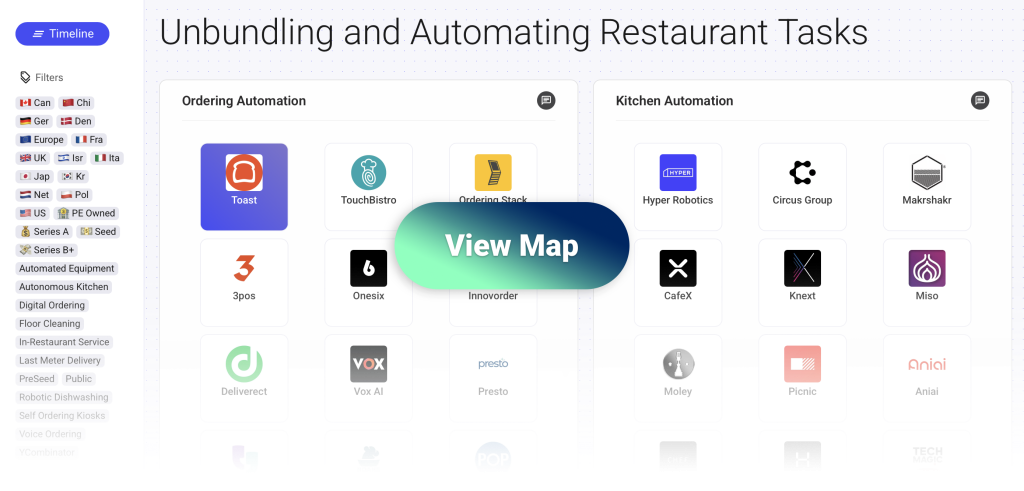
The mapping below shows a concrete view of the companies that take over restaurant tasks at a time when fewer and fewer people want to fill these roles (so it’ll be beneficial in the long term).
Insights
Here a couple of aspects and insights that stood out while doing this deep dive:
- AI and robotics are coming for the whole restaurant value chain. I broke the value chain into five categories that reflect how restaurants work: ordering, food preparation, meal delivery (in-restaurant or at home), cleaning (dining room and dishes) and inventory/supply management. And at every stage I could find companies automating tasks that were traditionally handled by humans.
- Robots are built mostly by Chinese and US firms. Chinese players are clearly ahead, followed by the US. I found several very interesting European companies, but far fewer in number.
- Proprietary hardware or off-the-shelf hardware. Among companies that rely on hardware you see two models. Some build and commercialize their own proprietary hardware. Others follow an off the shelf model where they buy robots from suppliers (mostly Chinese) and sell them with their own software and services on top.
- The convergence of online and offline, and of digital and physical. One thing that stood out for me is how everything is converging for restaurant businesses. Customers can order by phone, online, drive through or through self ordering kiosks and an AI agent can handle all channels. Some automated kitchens are already connected to these ordering systems so the food is prepared automatically by the robotic equipment. The restaurant of tomorrow will be fully connected and every part of the value chain will converge.
- Autonomous kitchens or equipment. In kitchen robotics I saw two main trends. Automated equipment that prepares food but still needs a human operator. And fully autonomous kitchens that run as complete restaurants where customers pay and receive their food without interacting with a human. Both models make sense and each one will fit different market segments.
- We are still early. It is a long term horizon, but it is coming. It will probably take time before most restaurants become highly automated, but this is the clear direction of travel. Technology and demographics are pushing in the same direction, with fewer people wanting to do these tasks. It is not a fad, it is a structural trend.
- Humans are still needed. I also believe humans will stay in the loop, but their role will change. They will become operators of the equipment/autonomous kitchen. There will also be a whole market of maintenance and parallel services (refill ingredients) that will continue to rely on human workers.
Conclusion
Where will the value be captured? The main question for me is not whether this shift will happen, but who will capture the value. It is not obvious (to me at least). Will robot manufacturers become large companies or will they end up as commodities. Will service and robot providers capture most of the value or will it be the brands that benefit, for example fast food chains that become more profitable as they automate a growing part of their operations (I can imagine a McDonalds becoming even bigger because of automation). If you have strong opinions about it, don’t hesitate to share it with me 🙂