
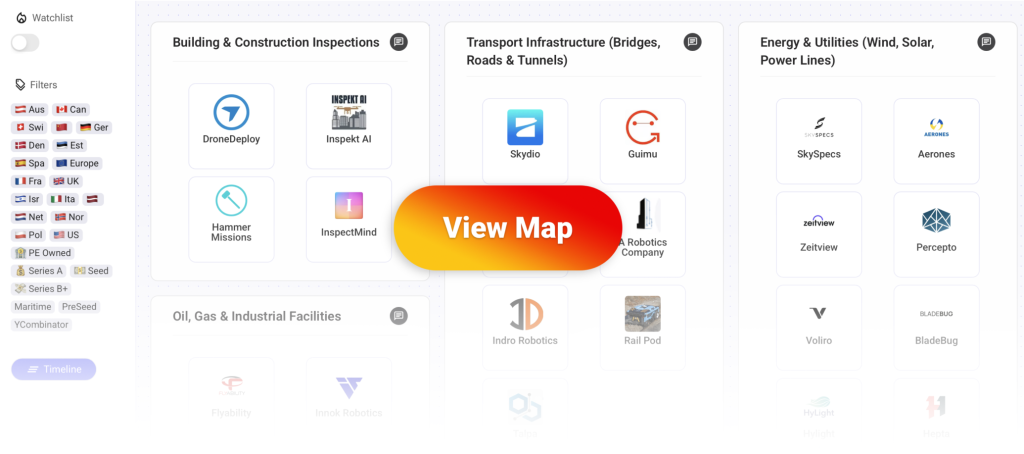
This post is part of a series covering the unbundling of physical inspection. You can view the full interactive map with more than 40 startups here.
The Unbundling of Physical Inspection
In many industries, inspections have traditionally been carried out by human inspectors checking for defects, damage, or maintenance needs. Today, advances in robotics, drones, and AI are unbundling these tasks and automating physical inspections (often still under human supervision). The competitive landscape above is an overview of major categories of physical inspections and companies automating these processes.
Building & Construction Inspection
How inspection is traditionally done:
- Inspectors physically walk through construction sites, rooftops, and facades to check for visible damage or non compliance with plans.
- Scaffolding or lifts are often required to reach high and hard-to-access areas. Which increases time, cost, and risk.
- Manual measurements and photos are taken to document cracks, corrosion, or deformation.
- Assessment quality depends heavily on human experience.
How AI and robotics are changing it:
- Drones capture high resolution imagery and 3D models of structures without the need for scaffolding or rope access.
- Computer vision models automatically detect cracks, leaks, rust, or missing components in images and videos.
- Ground and wall climbing robots inspect confined or hazardous areas that humans cannot easily access.
- AI systems compare progress photos or BIM (Building Information Modeling) data over time to detect deviations and predict maintenance needs.
- Cloud platforms centralize inspection data. It enables automated reporting.
4 Startups Automating Building & Construction Inspections

🇺🇸 US – 💸 Series B+
What they do:
- The company provides a platform that enables aerial and ground based data collection, modelling and analysis for job sites and assets.
- It serves industries like construction, utilities, oil & gas, mining and renewable energy by enabling monitoring of progress, quality, safety and maintenance.
- Users can upload imagery (from drones, cameras, site-cams) to generate 2D maps, 3D meshes and point clouds.
- It also offers integrations and workflows that support operations and maintenance phases (not just construction). So asset lifecycle visibility is improved.
Company specificities:
- DroneDeploy emphasizes “real AI” that understands the site by leveraging a large dataset of geo tagged imagery and domain specific models.
- Their platform supports both aerial drone capture and ground/robotic capture. It enables a more holistic view of an asset.
- They enable lifecycle coverage: from pre-construction and earthworks through interior, exterior, to operations and maintenance.
- The company has built a broad ecosystem with supported hardware, services (e.g., capture services), and integrations which reduce barrier to entry for large scale deployment.
🇺🇸 US
What they do:
- They provide AI-powered drone inspections of building facades, roofs and complex exterior structures, capturing high-resolution visual and thermal imagery.
- Their platform includes a defect analysis dashboard, 3D modelling and elevation drawing mapping. It enables asset owners to visualise conditions and track changes over time.
- The solution is tailored for a variety of property types: From hotels, commercial buildings, residential towers to industrial warehouses and infrastructure projects.
- They support contractor management and integrate with BIM dashboards and GIS maps.
Company specificities:
- Their combined use of drone capture plus AI-analysis emphasises reaching “inaccessible spots often missed” and producing faster, cheaper inspections.
- They include thermography in their offering to detect energy leaks and envelope inefficiencies.
- The inspection data is delivered through a defect dashboard and reporting engine that enable non-technical stakeholders to understand results and take action.
🇪🇺 Europe – 🇬🇧 UK – 💵 Seed
What they do:
- They provide a software platform for drone flight planning, aerial data capture, and processing into high-resolution 2D maps and 3D models for assets like roofs, façades, towers, and infrastructure.
- Their solution serves building surveyors, property managers, asset owners, and inspection teams who need to document exterior conditions and monitor changes over time.
- Users can upload imagery into their cloud platform, annotate models, perform measurements, and share results with stakeholders in a centralised environment.
- The platform includes AI tools that automatically detect defects such as cracks, corrosion, or surface deformation.
Company specificities:
- Their flight planning engine supports multiple mission types tailored to specific workflows like façade inspections, roof surveys, and structural mapping.
- They support a wide range of drone brands, making it easier for inspection teams to adopt the platform regardless of their hardware.
- Their AI module, Spector AI, enables survey teams to detect anomalies, quantify damage, and generate reports faster with less manual review.
- The platform unifies data capture, processing, measurement, and collaboration, reducing fragmentation across the inspection workflow.

🇺🇸 US – 💵 Seed – YCombinator
What they do:
- They provide an AI-powered mobile and cloud application that transforms field inspections into structured reports by capturing voice notes, images and videos directly on site.
- Their tool is tailored for construction, engineering, real estate and other field inspection use cases where professionals generate reports.
- Users can initiate an inspection via smartphone or tablet, annotate visual evidence and then receive automated report drafts (Word or PDF) ready for review.
- The platform supports real time collaboration, offline capture in remote locations and secure cloud storage of inspection documentation.
Company specificities:
- Their AI claims to reduce report writing time by up to 80 %.
- They offer industry specific templates (structural evaluations, site observations, forensic inspections) which help standardize output and make adoption easier for domain users.
- The application bridges site capture (voice, photo, video) with automated report production and a simple share/download workflow, lowering the barrier for field teams to adopt digital inspection.
- Their mobile first experience (iOS and Android) plus offline capability ensures usability in remote or connectivity limited environments.